

Alloy steel pipes are widely used in various industries due to their excellent mechanical properties and corrosion resistance. As a reliable alloy steel pipe supplier, I often receive inquiries about how to calculate the weight of alloy steel pipes. In this blog post, I will share some common methods and formulas for calculating the weight of alloy steel pipes, which will help you make more accurate procurement decisions.
Understanding the Basics of Alloy Steel Pipes
Before we dive into the calculation methods, it's important to understand some basic concepts related to alloy steel pipes. Alloy steel pipes are made by adding various alloying elements to carbon steel, such as chromium, nickel, molybdenum, and vanadium. These alloying elements improve the strength, toughness, and corrosion resistance of the pipes, making them suitable for applications in high - pressure, high - temperature, and corrosive environments.
The weight of an alloy steel pipe depends on several factors, including its outer diameter (OD), wall thickness (WT), and length (L). Different types of alloy steel pipes may have different densities due to the varying composition of alloying elements, but for most common alloy steel pipes, a density of around 7.85 g/cm³ can be used as an approximation.
Calculation Methods
Method 1: Using the Standard Formula
The most common formula for calculating the weight of a seamless alloy steel pipe is as follows:
[W = 0.02466\times S\times (D - S)\times L]
Where:
- (W) is the weight of the pipe in kilograms (kg)
- (S) is the wall thickness of the pipe in millimeters (mm)
- (D) is the outer diameter of the pipe in millimeters (mm)
- (L) is the length of the pipe in meters (m)
Let's take an example to illustrate this formula. Suppose we have an alloy steel pipe with an outer diameter (D = 100) mm, a wall thickness (S = 5) mm, and a length (L = 6) m.
First, substitute the values into the formula:
[W=0.02466\times5\times(100 - 5)\times6]
[W = 0.02466\times5\times95\times6]
[W=0.02466\times2850]
[W = 69.281\space kg]
Method 2: Calculating Based on Volume and Density
Another way to calculate the weight of an alloy steel pipe is by first calculating its volume and then multiplying it by the density of the alloy steel.
The volume (V) of a hollow cylinder (which represents the cross - sectional shape of a pipe) can be calculated using the formula:
[V=\pi\times\frac{(D^{2}-d^{2})}{4}\times L]
Where (d = D - 2S) is the inner diameter of the pipe.
After calculating the volume (V) in cubic centimeters ((cm^{3})), we can find the weight (W) using the formula (W=\rho\times V), where (\rho) is the density of the alloy steel in grams per cubic centimeter ((g/cm^{3})).
Let's use the same example as above. First, calculate the inner diameter (d = 100-2\times5=90) mm.
The volume (V) in (cm^{3}):
[L = 6m=600cm], (D = 10cm), (d = 9cm)
[V=\pi\times\frac{(10^{2}-9^{2})}{4}\times600]
[V=\pi\times\frac{(100 - 81)}{4}\times600]
[V=\pi\times\frac{19}{4}\times600]
[V=\pi\times2850\approx 8953.5\space cm^{3}]
Assuming a density (\rho = 7.85g/cm^{3}), the weight (W) in grams is (W=\rho\times V=7.85\times8953.5 = 70285.975\space g\approx70.29\space kg)
The slight difference between the results of the two methods is due to the approximations in the formulas.
Factors Affecting the Accuracy of Calculation
- Alloy Composition: As mentioned earlier, different alloy compositions can result in different densities. For example, alloy steel pipes with a high chromium or nickel content may have a higher density than standard carbon - alloy steel pipes. If high accuracy is required, it is recommended to obtain the exact density of the specific alloy steel from the material specification.
- Manufacturing Tolerances: In the manufacturing process of alloy steel pipes, there may be some tolerances in the outer diameter, wall thickness, and length. These tolerances can affect the calculated weight. When purchasing alloy steel pipes, it's important to check the manufacturer's tolerance range.
Different Types of Alloy Steel Pipes and Their Applications
As an alloy steel pipe supplier, we offer a wide range of alloy steel pipes to meet different customer needs. Here are some popular types:
- DIN2391 Seamless Precision Steel Tubes: These tubes are known for their high precision in dimensions and excellent surface finish. They are widely used in hydraulic and pneumatic systems, as well as in machinery manufacturing.
- ASTM A691 Grade 1 CR Alloy Steel Pipe: This type of pipe is suitable for high - temperature and high - pressure applications in the power generation and petrochemical industries. It has good creep resistance and oxidation resistance.
- ASTM A213 Gr T5 Seamless Tube: Commonly used in boiler and superheater applications, ASTM A213 Gr T5 seamless tubes offer high strength and corrosion resistance at elevated temperatures.
Conclusion and Call to Action
Calculating the weight of alloy steel pipes is an important step in the procurement process. By using the appropriate formulas and considering the factors that affect the accuracy of the calculation, you can make more informed decisions when purchasing alloy steel pipes.

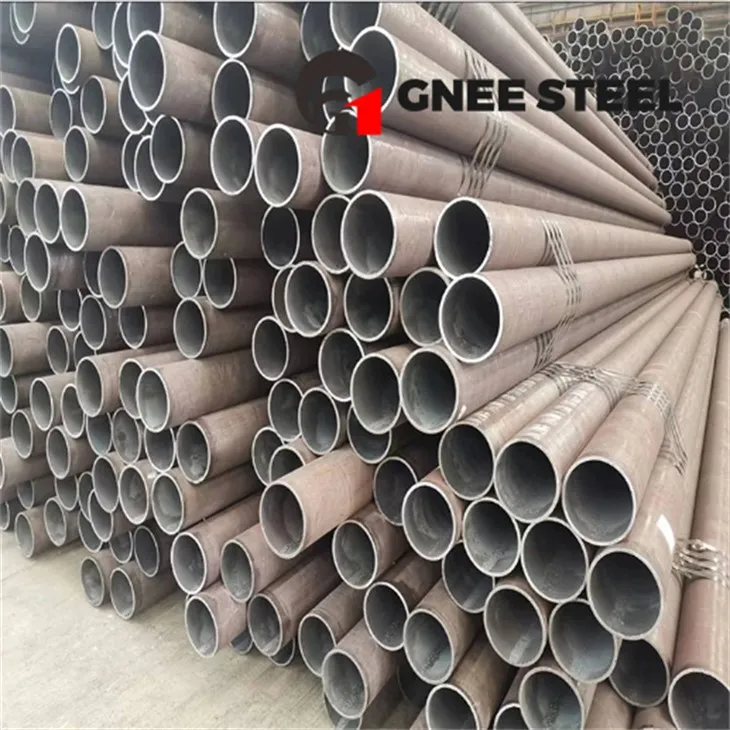
As an experienced alloy steel pipe supplier, we are committed to providing high - quality products and professional services. If you have any questions about alloy steel pipes, such as calculating weights, choosing the right type for your application, or getting a quote, please feel free to contact us for procurement and further discussion. We look forward to serving you and meeting your alloy steel pipe needs.
References
- ASME Boiler and Pressure Vessel Code
- ASTM International Standards for Alloy Steel Pipes
- Manufacturing specifications of alloy steel pipes from leading manufacturers