


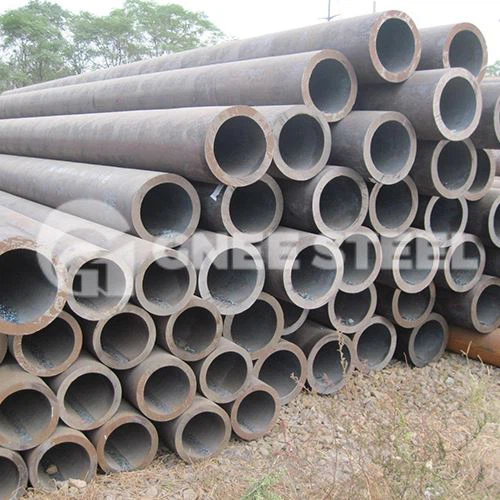


A210 seamless carbon steel boiler tube is a medium carbon seamless steel tube for boilers and superheaters. It is produced by hot rolling process and delivered in hot rolled and heat treated state. The outer diameter is 57mm~762mm and the wall thickness is 3.0mm~130mm.
ASTM A210 seamless steel pipe is a medium carbon manganese steel pipe, which belongs to pearlite heat-resistant steel. This steel pipe has high strength, good plasticity and toughness. It can be used to transport high-pressure, high-temperature oil and gas mixtures and various corrosive media, and manufacture equipment such as boilers, superheaters and reheaters, as well as structural support and connection parts.
GNEE specializes in the production of A210 high-pressure boiler tubes. If you need it, please contact us immediately.
A210 Boiler Tube Specification
| Parameter | Range or requirement |
|---|---|
| Product form | Seamless, hot-finished or cold-finished |
| Standard scope | OD 12.7–127 mm (½–5 in); minimum wall 0.9–12.7 mm (0.035–0.500 in) |
| Typical boiler sizes | OD 31.8–76.1 mm (1.25–3 in); wall 3.0–10.0 mm; other sizes by agreement |
| Length | As specified; random or fixed lengths, U-bends to drawing |
| Tube ends | Plain square-cut, or bevelled for butt welding |
| Delivery condition | Hot-finished, or cold-finished with required heat treatment |
| Wall basis | Minimum wall (not average wall) |
| Marking | Grade, heat number, size and standard on each tube |
A210 is a minimum-wall specification. That is not the same as the average-wall basis used by A179 heat-exchanger tube, where the actual wall may fall below the nominal figure; A210 guarantees a floor. Tubes outside the standard OD and wall scope can be supplied only by agreement and must meet every other requirement of the specification. "All sizes available" is not a substitute for a confirmed supply range.
Chemical Composition: A-1 vs C
Both grades are killed steel. The only chemical difference that drives grade selection is carbon and the manganese band that travels with it; the impurity and silicon limits are the same.
| Element, % (heat analysis) | Grade A-1 | Grade C | Function |
|---|---|---|---|
| Carbon (C) | 0.27 max | 0.35 max | Strength; higher in C for higher allowable stress |
| Manganese (Mn) | 0.93 max | 0.29–1.06 | Strength, hardenability, deoxidation |
| Phosphorus (P) | 0.035 max | 0.035 max | Impurity control |
| Sulfur (S) | 0.035 max | 0.035 max | Impurity control; inclusion shape |
| Silicon (Si) | 0.10 min | 0.10 min | Deoxidation |
Values are the A210/A210M heat-analysis limits. For each reduction of 0.01 % below the specified carbon maximum, manganese may be increased by 0.06 % above its maximum, up to a final manganese maximum of 1.35 %. Confirm product-analysis tolerances against the ordered edition. Some supplier pages quote 0.13–0.19 % carbon for A-1 and 0.24–0.31 % for C - those ranges belong to a low-carbon or confused grade and do not match A210.
Mechanical Properties and Hardness
The room-temperature requirements are acceptance limits that prove the heat was made and treated correctly. They are not design values; at boiler temperatures the wall is set by the allowable stress in the governing code, not by the room-temperature yield.
| Property (minimum) | Grade A-1 | Grade C | Verification |
|---|---|---|---|
| Tensile strength | 415 MPa (60 ksi) | 485 MPa (70 ksi) | Tension test |
| Yield strength | 255 MPa (37 ksi) | 275 MPa (40 ksi) | Tension test |
| Elongation in 50 mm (2 in) | 30 % | 30 % | Tension test, with reductions for walls under 8 mm |
| Hardness | 79 HRBW (143 HBW) | 89 HRBW (179 HBW) | Brinell or Rockwell, two tubes per lot |
Elongation is 30 % in 50 mm at full wall, with a deduction per the standard formula for walls thinner than 8 mm. Mechanical-property requirements do not apply to tubes smaller than 3.2 mm inside diameter or 0.4 mm wall. Hardness limits are reported per lot and are a practical check on cold working and heat treatment, not a primary design value.
Manufacture and Heat Treatment
A210 tubes are made by the seamless process from killed steel and are supplied hot-finished or cold-finished, as specified. The heat-treatment obligation depends on which route is used.
| Condition | Heat treatment requirement |
|---|---|
| Hot-finished | Need not be heat treated |
| Cold-finished | Subcritical anneal, full anneal, or normalising after the final cold-finishing operation |
A210 Tube and A106 Pipe: Not Interchangeable
| Aspect | ASTM A210 (tube) | ASTM A106 (pipe) |
|---|---|---|
| Product | Boiler and superheater tube | Seamless carbon-steel pipe for high-temperature service |
| Ordering basis | OD and minimum wall thickness | NPS and wall schedule |
| Where used | Inside boilers, superheaters, heat exchangers | External process piping, ASME B31.3 |
| Pressure test | Per A210 and A450 (boiler-code basis) | Per A106 / B31.3 pipe basis |
| Certificate | Tube MTC / ASME MTR | Pipe MTC / ASME MTR |
Equivalent Grades
| System | Grade | Status against A210 |
|---|---|---|
| EN 10216-2 | P265GH (1.0425) | Closest comparable to Grade A-1; not an exact equivalent |
| JIS G3461 | STB410 (A-1), STB510 (closer to C) | Japanese boiler-tube counterparts; confirm chemistry |
| GB/T 5310 | 20G (approx. A-1) | Chinese high-pressure-boiler grade; approximate, not direct |
| ASTM A106 | Grade B pipe | Different product family (pipe, not tube) |
| ASTM A213 | T11, T22 alloy | Specified above A210's temperature or allowable-stress limit |
test and inspection


Send the standard and edition, grade, outside diameter and minimum wall, length and quantity, hot-finished or cold-finished condition, heat treatment, test route, certificate scope and required delivery date to receive a quotation.
FAQ
What is ASTM A210 seamless carbon boiler tube?
ASTM A210/A210M, adopted as ASME SA-210, is a specification for seamless medium-carbon steel tubes for boilers, boiler flues, superheaters, arch tubes and stay tubes. It covers minimum-wall-thickness tubing made by the seamless process from killed steel, supplied hot-finished or cold-finished. It is a tube standard, not a pipe standard: it is ordered by outside diameter and minimum wall thickness and is used inside boiler and heat-exchanger equipment rather than as external process piping.
What grades does ASTM A210 cover?
The current A210 covers two grades, Grade A-1 and Grade C. Grade B existed in older editions but was deleted, so any page or quotation that lists A210 Grade B is referencing an obsolete grade and should be treated with caution. Grade A-1 is the general-service grade with carbon up to 0.27 % and a 415 MPa minimum tensile strength. Grade C has carbon up to 0.35 % and a 485 MPa minimum tensile strength for higher-pressure and higher-temperature sections.
What is the difference between A210 Grade A-1 and Grade C?
Grade C allows more carbon and a wider manganese band than Grade A-1, which raises the minimum tensile strength from 415 MPa to 485 MPa and the minimum yield from 255 MPa to 275 MPa. That extra strength supports thinner walls or higher pressure in superheater and reheater sections. The trade-off is weldability: Grade C's higher carbon means preheat and controlled procedures are more important, whereas Grade A-1 is the easier and more economical grade for general boiler-bank and economizer service.
Is ASTM A210 a tube or a pipe?
A210 is a tube standard. It is ordered by outside diameter and minimum wall thickness for use inside boilers, superheaters and heat exchangers, and it carries boiler-code hydrostatic and NDE requirements. A106 is the pipe standard in the same carbon-steel family: it is ordered by NPS and wall schedule for external high-temperature process piping under ASME B31.3. The two are not interchangeable - a pipe certificate does not satisfy a tube specification and vice versa.
What is the maximum service temperature for A210 boiler tube?
Carbon steel's practical continuous-service limit is about 425 to 450 °C. Above roughly 425 °C, long-term exposure can cause graphitisation and creep becomes the controlling failure mode, so the wall grows uneconomically thick. For metal temperatures above about 480 °C, chromium-molybdenum alloy tubes such as A213 T11 and T22 are specified instead. A210 is therefore used in water walls, economizers and the cooler superheater stages, not in the hottest final superheater positions.
Is A210 tube suitable for safe ending by forge welding?
No. A210 Note 1 states the tube type is not suitable for safe ending by forge welding, which is the practice of forge-welding a thickened end onto a tube for rolling into a tubesheet. That restriction is a reason to confirm the fabrication route with the tube mill and the boiler designer before assuming a safe-end design, and it is one of the details that distinguishes A210 procurement from a generic carbon-steel tube order.
What inspection and material certificates apply to A210 tubes?
A210 requires a hydrostatic test on every tube, or a non-destructive electric test in its place where the purchase order allows it, plus tension, flattening, flaring and hardness tests. Cold-finished tubes are heat treated after drawing. The material test certificate, typically EN 10204 3.1, records heat analysis, mechanical results, heat treatment where applicable, dimensions and the heat number for traceability; ASME MTR is used for Code construction.
What should a purchase order for A210 tubes specify?
State the standard and edition, ASTM A210 or ASME SA-210; the grade, A-1 or C; outside diameter and minimum wall thickness; length and quantity; hot-finished or cold-finished; any heat treatment such as normalising for cold-finished tube; the test route, hydrostatic or non-destructive electric; the material test certificate level; any third-party inspection; marking and heat-number traceability; and the design code and service temperature so the grade and allowable stress basis can be confirmed.
Hot Tags: a210 seamless carbon boiler tube, China a210 seamless carbon boiler tube manufacturers, suppliers, factory, seamless boiler pipe smoothness, seamless boiler pipe scattering coefficient, seamless boiler pipe dent, seamless boiler pipe quality assurance, seamless boiler pipe heat treatment, seamless boiler pipe radio frequency interference


