


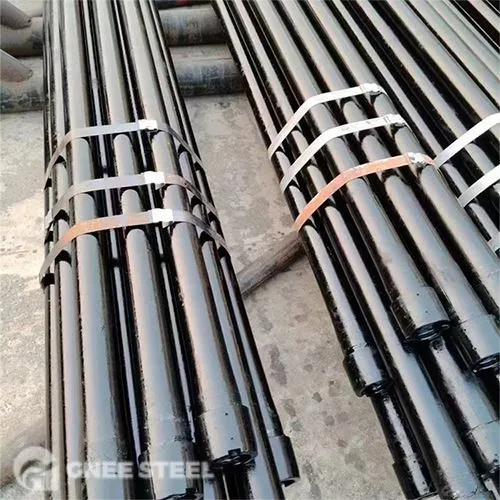


API 5CT P110 Casing and tubing Description
API 5CT P110 petroleum steel pipe is a premium grade of Oil Country Tubular Goods (OCTG) manufactured in accordance with API Spec 5CT, the latest applicable edition for casing and tubing used in oil, gas, geothermal, and coalbed methane drilling and completion operations. As a high-strength steel grade, P110 casing and tubing provides exceptional mechanical performance, making it suitable for deep and ultra-deep wells, high-pressure formations, and complex downhole environments worldwide.
API 5CT P110 Definition and Grade Designation
The designation P110 follows the API 5CT grading rules for heat-treated OCTG:
P: Premium steel grade subjected to full-length quenching and tempering (Q), the only approved heat treatment for P110. Normalizing (N) or normalizing & tempering (N&T) is not permitted.
110: Minimum yield strength of 110,000 psi (758 MPa). The yield strength range of P110 is 758–965 MPa, with a minimum tensile strength of 862 MPa.
Compared with conventional grades such as J55, K55, and N80, P110 provides approximately 37.5% higher strength, enhanced collapse resistance, and superior tensile performance, making it the preferred choice for medium, deep, and ultra-deep well applications.
API 5CT P110 OCTG Pipe Manufacturing Process and Material Requirements
Production Types
P110 pipe is available in seamless and ERW (Electric Resistance Welded) forms:
Seamless P110: Preferred for critical deep wells due to uniform metallurgical properties and superior mechanical reliability.
ERW P110: Typically used for medium-depth wells or non-critical applications; stricter sulfur and phosphorus limits ensure weld integrity.
API 5CT P110 oil country tubular goods Chemical Composition
To prevent hot and cold brittleness, sulfur (S) and phosphorus (P) contents are strictly controlled. Carbon, manganese, chromium, molybdenum, nickel, and copper do not have mandatory lower limits under API 5CT 10th Edition.
| Element | Seamless P110 | ERW P110 |
|---|---|---|
| Phosphorus (P) | ≤ 0.030% | ≤ 0.020% |
| Sulfur (S) | ≤ 0.030% | ≤ 0.010% |
| Carbon (C) | 0.25–0.35% | 0.25–0.35% |
Carbon content is carefully controlled to balance strength and weldability, while minimizing the risk of welding cracks.
Carbon content is typically controlled within a range determined by the manufacturer to achieve the required mechanical properties and weldability.
Mandatory Heat Treatment
All P110 pipes must undergo full-length quenching and tempering (Q). This heat treatment ensures optimal strength-toughness balance and stable downhole performance. Heat treatment is a core acceptance criterion for all P110 orders.
API 5CT P110 Oil Well Drilling Tube Mechanical and Hardness Properties
| Property | Value | Unit |
|---|---|---|
| Minimum Yield Strength | 758 | MPa |
| Maximum Yield Strength | 965 | MPa |
| Minimum Tensile Strength | 862 | MPa |
| Hardness Range | 23–30 | HRC |
Hardness is measured on both the pipe body and threaded ends.
P110 hardness is controlled in accordance with API 5CT requirements. In manufacturing practice, values are commonly maintained below 30 HRC to balance strength and toughness.
Rockwell C (HRC) hardness testing is the official reference method specified by API 5CT.
Controlled hardness prevents brittle fracture while maintaining high pressure-bearing capacity.
API 5CT P110 OCTG Pipe Dimensions and Specifications
Common Outer Diameters (OD)
| OD (mm) | Typical Application |
|---|---|
| 114.3 / 139.7 | Commonly used for production casing, liners, and completion strings |
| 177.8 | Medium-depth wells with wellbore stability requirements |
| 244.5 | Deep wells, high-pressure formations |
| 273.05–508 | Large casing for ultra-deep wells or major field development |
Wall Thickness
Common range: 5.21–16.13 mm.
Thin-wall pipes (<7.72 mm): Lightweight, cost-effective for simple geological conditions.
Thick-wall pipes (≥10.03 mm): Enhanced collapse resistance and internal pressure resistance, suitable for high-pressure and complex formations (e.g., salt-gypsum layers).
Note: Wall thickness selection should consider OD, formation stress, and downhole conditions.
Standard Length Series
| Series | Length (m) | Application |
|---|---|---|
| R1 | 4.88–7.62 | Shallow wells, sites with transportation/construction constraints |
| R2 | 7.62–10.36 | Most conventional wells |
| R3 | ≥10.36 | Deep wells; reduces connection joints, improves sealing performance |
Thread Types and Technical Parameters
Thread connection is critical for sealing and structural integrity. P110 casing offers three standard types:
| Thread Type | Features | Typical Use |
|---|---|---|
| STC (Short Round Thread) | Low cost, easy machining | General sealing requirements |
| LTC (Long Round Thread) | Higher connection strength | Medium-pressure wells |
| BTC (Buttress Thread) | Higher connection strength and improved sealing performance compared with round threads. | Deep/high-pressure wells, hydraulic fracturing |
Thread angles:
Standard round: 60°
Buttress: 3°/30° tooth angle
Thread pitch varies depending on pipe size and thread type. Many standard API round threads use 8 TPI.
API 5CT P110 oil country tubular goods Functions and Applications
Core Functions
Support wellbore and prevent collapse
Isolate formations to avoid cross-flow of oil, gas, and water
Withstand high internal and external pressure differentials
Provide structural integrity in non-sour environments. Additional corrosion protection may be required in CO₂-containing wells.
Typical Application Fields
Technical and production casing for deep and ultra-deep oil/gas wells
High-pressure gas wells and hydraulic fracturing sections
Shale gas, coalbed methane, and geothermal wells
Wells with salt-gypsum formations or strong external extrusion forces
Usage Limitation
Do not use in H₂S (sour) environments. Standard P110 cannot resist sulfide stress cracking.
For acidic or sour wells, choose sulfur-resistant grades: L80, C90, T95.
Comparison with Other API OCTG Grades
| Grade | Key Differences |
|---|---|
| N80 | P110 has higher strength. Using thick-wall N80 to match P110 increases weight and reduces inner diameter. Thin-wall P110 is more economical and reliable for deep wells. |
| L80 | Similar heat treatment; L80 is for sour service, P110 is not H₂S-resistant. |
| Q125 | Higher-strength grades for extreme depths/pressures. P110 is more cost-effective for most deep wells. |
API 5CT P110 OCTG Pipe Test and inspection


API 5CT P110 Casing Tubing certificate

FAQ
Q1: What standard does P110 follow?
A1: API Spec 5CT, 10th Edition.
Q2: What is the required heat treatment?
A2: Full-length quenching and tempering (Q). Normalizing or N&T is not allowed.
Q3: Can P110 be used in sour wells?
A3: No. Use L80, C90, or T95 instead.
Q4: What are the main thread types?
A4: STC, LTC, BTC. BTC is preferred for deep/high-pressure wells.
Q5: What is the yield strength range?
A5: 758–965 MPa (minimum tensile 862 MPa).
Q6: What is the difference between seamless and ERW P110 pipe?
A6: Seamless P110: uniform properties for critical deep wells. ERW: stricter P&S limits, used for medium-depth wells.
Q7: What are the standard lengths?
A7: R1 (4.88–7.62 m), R2 (7.62–10.36 m), R3 (≥10.36 m).
Q8: Required inspection documents?
A8: MTC, chemical report, mechanical test, NDT, dimensional & thread inspection records.
API 5CT P110 petroleum steel pipe is a high-reliability, high-strength OCTG product. With stable mechanical performance, complete specifications, and competitive cost, it has become a key material for global deep oil and gas exploration. Proper selection based on well depth, formation pressure, and downhole conditions maximizes service life and operational safety.
For non-sour, high-pressure, deep wells, API 5CT P110 remains one of the most widely specified and cost-effective OCTG grades available today.
Hot Tags: api 5ct p110 petroleum steel pipe, China api 5ct p110 petroleum steel pipe manufacturers, suppliers, factory


