


ASTM A214 is not a strength specification. It is a weld specification. The tube is made by electric resistance welding, which leaves one straight seam down its length, and the whole standard exists to prove that this seam behaves like the parent metal - through flattening, through flanging, through hardness, and through a heat treatment that erases the weld structure after it is made. Bright annealing is the finishing step that lets a buyer skip pickling without giving up surface quality. On a condenser with forty thousand tubes, that difference shows up in the schedule.
ASTM A214 is issued in parallel as ASME SA214, and the two documents are technically identical. In a purchase order the name matters less than the edition, because the general requirements live in ASTM A450 and that reference is where most of the dimensional and testing detail actually comes from.
Specification
| Item | Specification |
|---|---|
| Standard | ASTM A214 / ASME SA214; general requirements to ASTM A450 |
| Product form | Electric resistance welded (ERW), single longitudinal seam |
| Type | Minimum wall thickness tube; outside diameter and minimum wall are specified, inside diameter is not |
| Outside diameter | 1/8–3 in (3.2–76.2 mm) standard; other sizes by agreement |
| Wall thickness | Commonly 12–22 BWG (2.77–0.71 mm); heavier and lighter walls on request |
| Length | Straight lengths to 20 ft (6.1 m); longer and U-bent on request |
| Carbon | 0.18% max |
| Manganese | 0.27–0.63% |
| Phosphorus / sulphur | 0.035% max each |
| Tensile strength | 47 ksi (325 MPa) min |
| Yield strength | 26 ksi (180 MPa) min |
| Elongation | 35% min |
| Hardness | 72 HRB max |
| Heat treatment after welding | 900 °C (1650 °F) or higher, air cooled or controlled atmosphere furnace cooled |
| Heat treatment after final cold draw | 650 °C (1200 °F) or higher |
| Delivery condition | Bright annealed (BA) as standard; stress relieved, normalized or as-drawn also available |
| Mandatory tests | Tensile, flattening, flange, hardness, hydrostatic or non-destructive electric test |
| Typical service | Surface condensers, feedwater heaters, oil coolers, chillers, U-tube exchangers |
Mechanical property requirements do not apply to tube smaller than 1/8 in (3.2 mm) inside diameter or thinner than 0.015 in (0.4 mm) wall. Confirm all values against the edition of A214 and A450 named in the purchase order.
Chemistry and Mechanical Properties
| Element | A214 | A179 (for comparison) |
|---|---|---|
| Carbon | 0.18% max | 0.06–0.18% |
| Manganese | 0.27–0.63% | 0.27–0.63% |
| Phosphorus | 0.035% max | 0.035% max |
| Sulphur | 0.035% max | 0.035% max |
The manganese range is narrow by any standard - a window of 0.36 points - and that is the point. This is not a steel designed for strength. It is a steel designed to be formed, welded, drawn and then rolled into a tube sheet without cracking. Low carbon keeps the weld ductile; the restricted manganese keeps hardness predictable through the heat treatment cycle. There is no silicon requirement and no micro-alloy addition, which is why A214 tube is not a candidate for high-temperature service.
| Property | Requirement |
|---|---|
| Tensile strength | 47 ksi (325 MPa) min |
| Yield strength | 26 ksi (180 MPa) min |
| Elongation in 2 in (50 mm) | 35% min |
| Hardness | 72 HRB max |
Note what is missing: there is no maximum yield and no maximum tensile. A214 does not cap strength, so a heat that comes back at 400 MPa tensile is compliant. That is fine for a heat exchanger, where the tube wall is set by corrosion allowance, baffle wear and the grip needed for rolling rather than by hoop stress. It is not fine if you were expecting a tight strength window - and if you need one, that is a conversation to have before the order, not after the certificate arrives.
Carbon steel tube of this grade is generally applied up to about 900 °F (480 °C). Above that, oxidation and creep take over and the selection moves to a chrome-moly grade or a stainless, which is a different article.
Sizes, Wall Thickness and Tolerances
| OD | mm | Common BWG walls | Typical use |
|---|---|---|---|
| 1/2 in | 12.7 | 16, 18, 20 | Small shell and tube exchangers, oil coolers |
| 5/8 in | 15.9 | 16, 18, 20 | Compact exchangers, chillers |
| 3/4 in | 19.05 | 14, 16, 18 | The workhorse size for condensers |
| 1 in | 25.4 | 12, 14, 16 | Feedwater heaters, process exchangers |
| 1-1/4 in | 31.75 | 12, 14, 16 | Large surface condensers |
| 1-1/2 in | 38.1 | 10, 12, 14 | Steam surface condensers |
| 2 in | 50.8 | 10, 12, 14 | Heavy duty exchangers, air coolers |
| 2-1/2 to 3 in | 63.5–76.2 | 10, 12 | Large process and marine condensers |
| BWG | Wall, mm | Comment |
|---|---|---|
| 10 | 3.40 | Heavy wall; high wear or corrosive duty |
| 12 | 2.77 | Common for 1 in and above |
| 14 | 2.11 | Standard for larger condenser tube |
| 16 | 1.65 | The most common heat exchanger wall |
| 18 | 1.24 | Light wall; expansion needs care |
| 20 | 0.89 | Small tube, clean service only |
| 22 | 0.71 | Minimum practical for rolled joints |
BWG wall figures are rounded nominal values. Order the wall as a minimum thickness, not as a gauge number, when the calculation depends on it.
A214, A179 and A192 Side by Side
| Item | A214 | A179 | A192 |
|---|---|---|---|
| Manufacturing route | ERW, welded | Seamless, cold drawn | Seamless, cold drawn |
| Carbon | 0.18% max | 0.06–0.18% | 0.06–0.18% |
| Tensile, min | 325 MPa | 325 MPa | 325 MPa |
| Yield, min | 180 MPa | 180 MPa | 180 MPa |
| Hardness, max | 72 HRB | 72 HRB | 72 HRB |
| Heat treatment | 900 °C after weld, 650 °C after final draw | 650 °C after final draw | 650 °C after final draw |
| Usual service | Heat exchangers, condensers | Heat exchangers, condensers | Boiler tubes, high pressure |
| Relative cost | Lowest | Higher | Higher again |
A214 and A179 have identical mechanical requirements, near-identical chemistry and the same applications. The difference is the route: A214 is welded, A179 is seamless. Everything else follows from that. A welded tube is cheaper to make and comes in longer lengths with better concentricity; a seamless tube has no seam to inspect because it has no seam. When a project specification says seamless for a low-pressure water box, it is usually buying comfort rather than capability - but it is the buyer's call, and it should be made deliberately.
The one place where the choice is not a preference: if the tube will be expanded and then seal welded, or if it will see wet H2S, the seam and its hardness distribution become a real technical question. A214 tube that has been properly normalised and bright annealed handles both. A214 tube that was welded and cooled without the 900 °C treatment does not, no matter what the certificate says about tensile.
How the Tube Is Made
Strip selection. Cold rolled, slit to width, chemistry checked against 0.18% carbon maximum and the 0.27–0.63% manganese window.
Forming. The strip is progressively rolled into a cylinder through a forming section, with the edges brought together under controlled pressure.
High frequency welding. The longitudinal seam is welded by resistance or induction at frequencies in the hundreds of kilohertz. No filler metal; the weld is forged from the two edges themselves.
Scarfing. The internal and external weld flash is removed, flush, without undercutting the wall.
Weld anneal. The seam passes through an in-line annealer at 900 °C or above, then cools. This is the step that A214 makes mandatory.
Cold drawing. The hollow is drawn over a mandrel to final OD and wall, which sets concentricity and surface finish and gives the tight wall control the process is known for.
Bright annealing. Final anneal at 650 °C or above in a controlled atmosphere, cooling in the same atmosphere so the surface stays bright.
Straightening, cutting, end finishing. Roller straightening, cut to length, square cut or bevelled, deburred.
Testing and packing. Eddy current over the full length, flattening and flange samples, dimensional check, marking, then bundling with protection.
What Bright Annealing Actually Does
Annealing in a protective atmosphere is not decoration. It removes a process step from your shop and removes a risk from the tube.
A conventional anneal leaves a dark oxide scale on the tube, inside and out. That scale has to be removed by acid pickling, and pickling brings its own problems: acid can be trapped in the bore of a long tube, rinse water quality becomes a variable, and hydrogen picked up during pickling has to be driven off afterwards. For a heat exchanger tube, a dirty bore is worse than a rough outside, because the bore is where the heat transfer happens and where the fouling starts.
Bright annealing runs the tube through a continuous furnace with a hydrogen or nitrogen-hydrogen atmosphere held at a dew point low enough - typically below −40 °C - that no oxide can form. The tube comes out with a metallic, scale-free surface, inside and out. No pickling, no rinse, no hydrogen bake-out.
| Property | Bright annealed | Annealed and pickled |
|---|---|---|
| Surface condition | Metallic, light and bright, no scale | Matte, requires pickling and rinsing |
| Bore cleanliness | Clean; no acid or rinse residue | Residual acid risk if rinse is inadequate |
| Wall thickness | Unchanged after anneal | Slightly reduced by pickling |
| Hydrogen pickup | None from processing | Possible during pickling; bake-out may be needed |
| Eddy current response | Low background noise, better defect discrimination | Scale and roughness raise noise |
| Ready for expansion | Yes, straight from the bundle | Usually needs cleaning before rolling |
| Cost | Higher per metre | Lower per metre, plus your own cleaning cost |
What bright annealing cannot do is fix a bad weld, correct an out-of-round tube, or compensate for a furnace that was not clean. Three conditions have to be met for the finish to be worth paying for:
The tube must go in clean. Drawing lubricant, copper residue or finger marks will carbonise in the furnace and leave grey smut that is harder to remove than the scale would have been. Degreasing before the furnace is not optional.
The atmosphere must be monitored, not assumed. Dew point and oxygen are logged continuously on a properly run line. A bright furnace that is drifting still looks bright at the door and produces a light oxide film at the far end.
Handling after the furnace must stay clean. Bright tube that is dragged across a dirty floor or packed without protection arrives looking like pickled tube. Paper interleaving and end caps are part of the product, not part of the packing.
Where This Tube Is Used
Surface condensers in power plants, where the tube count is high, the water is clean.
Feedwater heaters - often 1 in OD at 14 or 16 BWG, sometimes with a stainless or alloy upgrade on the high-pressure stage.
Oil coolers and heat exchangers in hydraulic and lubricating systems, where 1/2 to 3/4 in tube at 18 or 20 BWG is standard.
Chillers and refrigeration condensers, frequently with enhanced or finned surfaces on the same base tube.
U-tube exchangers, where the tube is bent after annealing and the seam position through the bend has to be agreed in advance.
Marine and offshore coolers, usually with a coating or a cupro-nickel upgrade where seawater is involved.
If the tube will be U-bent, the seam orientation matters. Bending puts the outside of the bend in tension and the inside in compression. Running the seam along the neutral axis keeps it out of both, and most bend specifications require it. That has to be settled at the tube order stage, because once the tube is cut and bundled the seam position is fixed.
A214 ERW Heat Exchanger and Condenser Tube Factory

Send the tube schedule - OD, minimum wall, length, quantity, straight or U-bent, and the test package you need. We will come back with a priced offer that states the delivery condition in full, the annealing atmosphere, the test records included and the certificate type, so the offer and the mill order say the same thing.
Request a Quote for A214 Bright Annealed Tube
Our Case
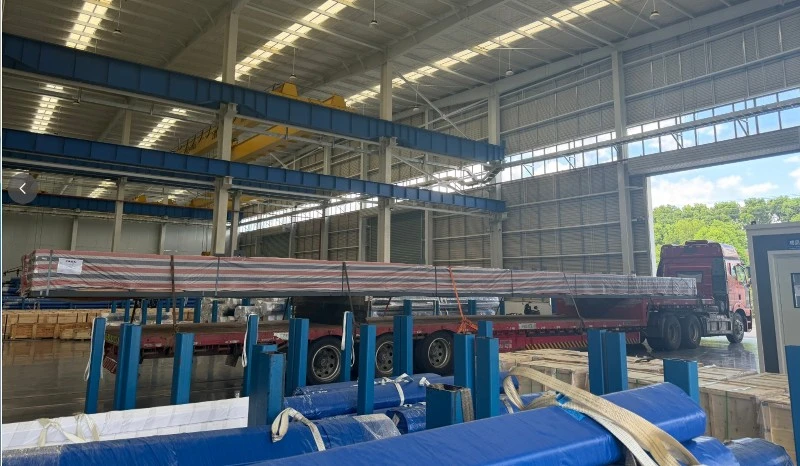
ASTM A214 ERW Heat Exchanger Tube: 1,500 Pieces Of 25.4 × 1.65 Mm, Bright Annealed
FAQ
Is A214 the same as A179?
Not the same, but closely related. They share the same minimum tensile, yield, elongation, hardness and applications, and their chemistry differs only in carbon: A214 allows up to 0.18% with no minimum, A179 requires 0.06–0.18%. The real difference is the manufacturing route. A214 is electric resistance welded; A179 is seamless and cold drawn. A214 is normally cheaper and comes in longer lengths.
Does A214 require heat treatment?
Yes, twice. Every tube must be heat treated at 900 °C (1650 °F) or above after welding, and again at 650 °C (1200 °F) or above after the final cold draw. A supplier who offers A214 tube with only the post-weld treatment has skipped the second requirement, and the resulting hardness is unlikely to stay under 72 HRB.
Does the standard mention bright annealing?
Not by name. A214 requires cooling in air or in the cooling chamber of a controlled atmosphere furnace, and bright annealing is the commercial way of doing the second option properly. Because the term itself is not defined in the standard, the order should state the requirement explicitly - atmosphere, dew point and resulting surface condition - rather than relying on the words "bright annealed" alone.
Can A214 tube be supplied above 3 inch outside diameter?
Yes, if it meets all the other requirements of the specification. The 3 in figure is the size range normally furnished, not a hard limit. In practice, most buyers above 4 in move to a welded pressure tube specification, because the heat exchanger tube standard no longer matches how the tube will be used.
Why can I not specify the inside diameter?
Because A214 is a minimum-wall specification. You control the outside diameter and the minimum wall, and the inside diameter is whatever those two produce. This is intentional: it allows the mill to run the wall on the plus side, which is good for the tube and harmless for the duty. If an exact bore is critical to your design, A214 is the wrong purchase specification.
Is the ERW weld a weak point in service?
Not when the tube is made and treated correctly. The seam is forged from the parent metal with no filler, then normalised at 900 °C or above, and it is verified by flattening and flange tests on every lot. Historically, ERW tube earned a poor reputation from low-frequency welding with uncontrolled heat input, and that reputation still gets quoted. Modern high frequency welding with in-line annealing and full-length eddy current testing is a different product.
Can A214 tube be used for U-bent bundles?
Yes, and it is common. Specify the bend radius, the length of both tangents, and the required seam orientation through the bend - normally on the neutral axis. Bending is done after the final anneal, so any cold work introduced by the bend is not relieved unless a stress relief after bending is specified.