


Based on their appearance, ASME B16.11 forged threaded pipe couplings are primarily categorized as single-ended and double-ended.
Half Threaded Coupling
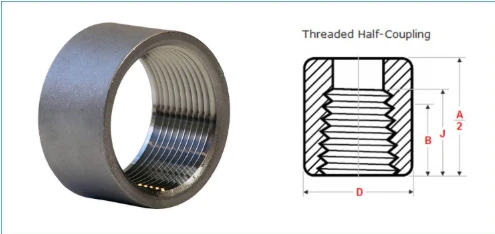
Half threaded couplings feature threads on one end and a different connection type or are used for sealing under specific conditions. They are commonly used for terminal pipeline connections or temporary sealing scenarios, offering easy installation and quick localized pipeline connection/sealing.
Key characteristics:
Only one end (inner or outer wall) is threaded, while the other end has a smooth bore (no internal threads) or a welding bevel.
Simple structure, relatively straightforward machining process, and lower cost.
During installation, only the threaded end requires sealing treatment, reducing operational steps.
Primary applications:
Used for "terminal connections" in piping systems, such as transitions between pipelines and equipment interfaces. The smooth end can be welded to equipment flanges or pipe ends, while the threaded end connects to the pipeline, enabling a "welded + threaded" hybrid connection that balances sealing and disassembly convenience.
Suited for frequently maintained sections of pipelines (e.g., instrument connections, short pipe sections before/after valves). The threaded end allows quick disassembly for maintenance, while the smooth end is welded to the main pipeline, minimizing disruption to the primary system.
Full Threaded Coupling

Full threaded couplings have threads on both ends and are used to connect two pipes of the same specification, enabling quick pipeline alignment. They offer significant advantages in scenarios requiring frequent disassembly or length adjustment, while their symmetrical design ensures connection stability and even force distribution.
Key characteristics:
Both ends feature internal threads, which may be of the same or different specifications.
Consistent thread precision on both ends allows for bidirectional pipeline connections.
No welding is required for pipeline alignment, ensuring high installation efficiency.
Pipeline length can be fine-tuned by adjusting thread engagement depth, accommodating on-site installation errors.
Primary applications:
When both ends have the same thread size, they are used for "straight-through connections" between pipes of identical diameter (e.g., extending straight pipe sections or repairing broken pipelines). They are widely used in oil and gas transmission for straight pipe connections.
When the thread sizes differ (reducing double-end threaded couplings), they enable "diameter transition connections" between pipes of different sizes (e.g., transitioning from DN50 to DN40 pipes). This eliminates the need for additional reducers, allowing seamless transitions directly through the coupling-commonly seen in chemical plant process line connections.