


JIS G3454 is the Japanese Industrial Standard specification for seamless carbon steel pipe for pressure piping. Its core material properties and application highlights are as follows:
Material Definition and Core Properties
Material Categories
Basic Composition: Unalloyed carbon steel, primarily low-carbon (carbon content ≤ 0.30%), ensuring weldability and plastic formability.
Grade System: The standard covers multiple strength grades, primarily STPG370, STPG410, and STPG480 (the number indicates the minimum tensile strength in MPa).
Mechanical performance requirements
| Grade | Tensile Strength (MPa) | Yield strength (MPa) | Elongation (%) |
|---|---|---|---|
| STPG370 | ≥370 | ≥205 | ≥25 |
| STPG410 | ≥410 | ≥245 | ≥23 |
| STPG480 | ≥480 | ≥275 | ≥21 |
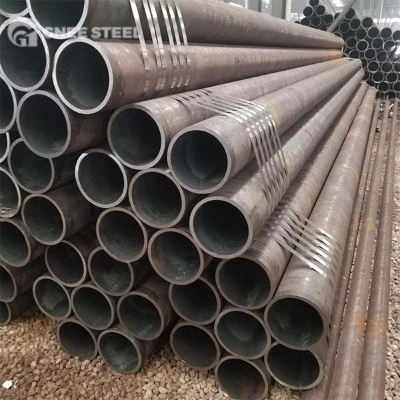
Chemical Composition Control
Low Carbon and Low Impurities: Phosphorus (P) and sulfur (S) contents are both ≤0.040%, reducing the risk of cold brittleness and hot cracking.
Manganese Content Adjustment: STPG370 has a manganese content of 0.30–0.90%. High-strength grades (such as STPG480) have an appropriately increased manganese content to enhance performance.
️ Manufacturing Process and Application Scenarios
Production Process
Seamless Steel Pipe: Formed through hot rolling or cold drawing, ensuring seamless pipes and improved pressure-bearing uniformity.
Mandatory Inspection Items: Hydrostatic testing (or non-destructive testing), dimensional tolerance verification (OD ±0.8%–1.6%, wall thickness ±10%–15%).
Applications
Pressure Piping Systems: Pipelines for conveying normal-temperature pressure media such as steam, hydraulic oil, and gas (design temperature typically ≤350°C). Prohibited Applications: Not suitable for high temperature (>350°C) or low temperature (<-10°C) operating conditions. For such applications, JIS G3456 (high temperature pipe) or alloy steel pipe should be used.