


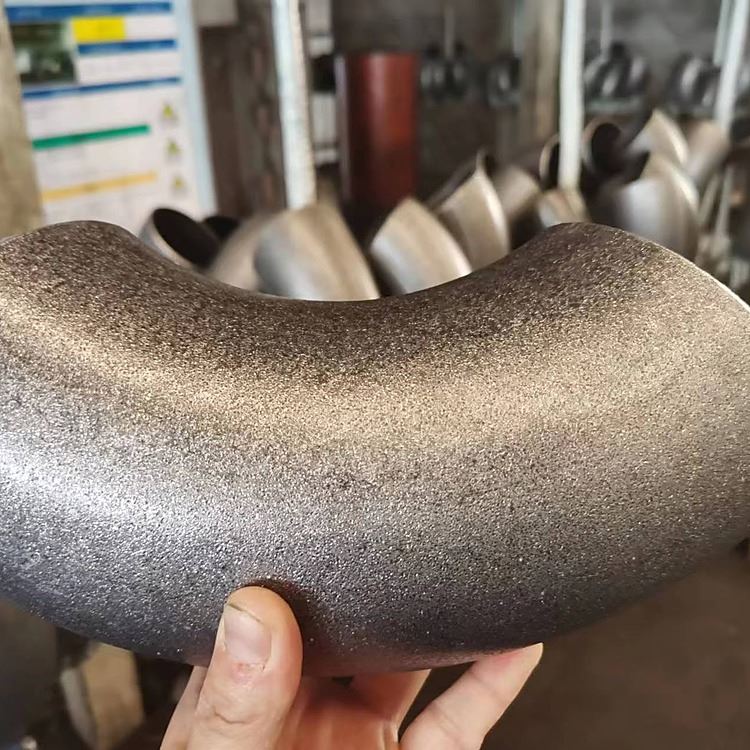
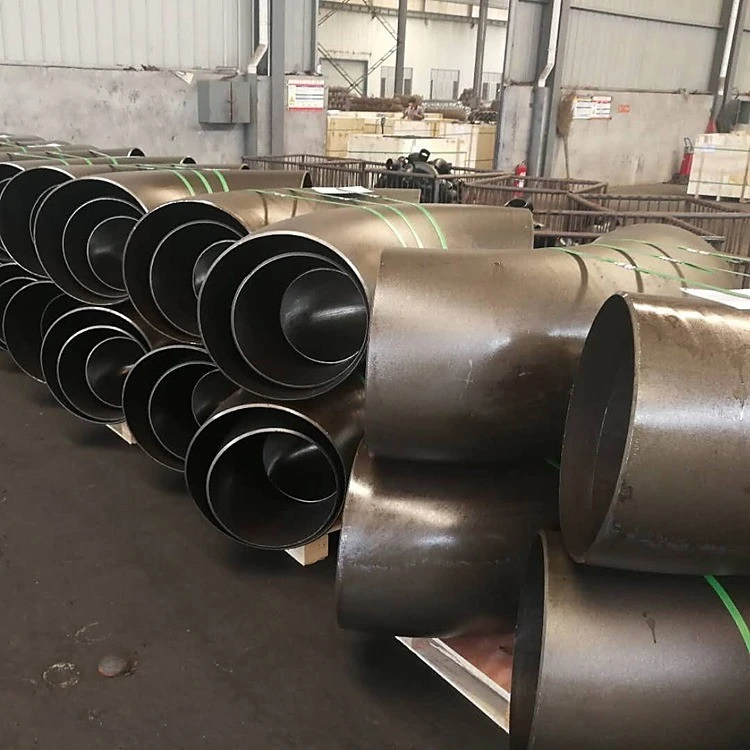
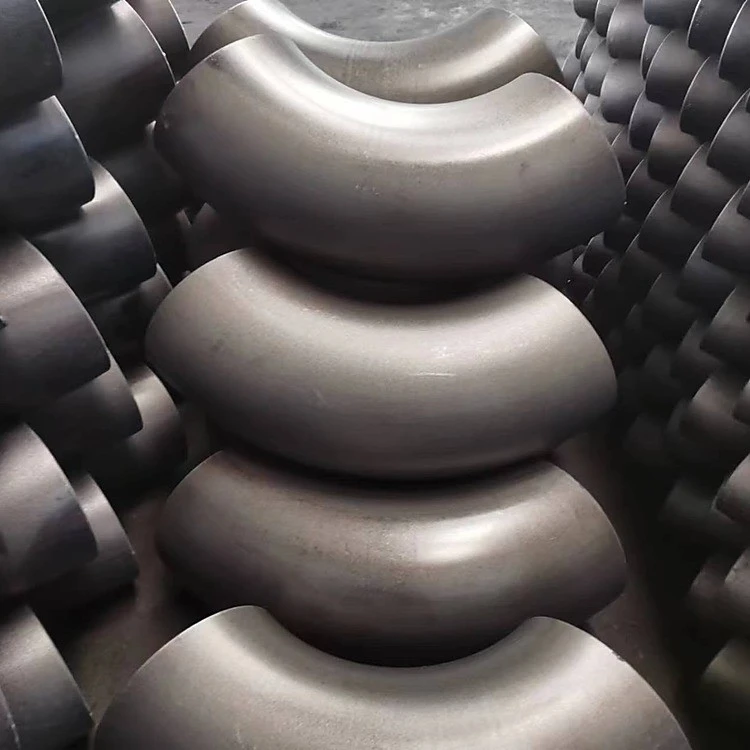
EN10253 P355NL1 elbow is a factory-made butt-welding pipe bend to EN 10253-2:2016, formed from normalized fine-grain P355NL1 plate or pipe (material 1.0566, EN 10028-3) for pressure lines in cold environments. In the Type B execution the wall in the bending and branch area is increased so the fitting stays rated at the full operating pressure of the matching pipe, rather than being the thinning weak point of the run. P355NL1 brings a 355 MPa minimum yield (up to 16 mm), 490 MPa minimum tensile and guaranteed Charpy toughness at minus 40 C - the grade is specified where a carbon-steel elbow must resist brittle fracture in low-temperature service. This page covers the grade chemistry, strength band, the 45 and 90 degree R=1.5D sizes, EN 10253-2 tolerances, the forming route, inspection documents and how to order these elbows.
Specification
| Item | Specified value |
|---|---|
| Standard | EN 10253-2:2016, butt-welding pipe fittings, non-alloy and ferritic alloy steels with specific inspection requirements |
| Fitting / angle | Elbow, 45° and 90°, long radius R=1.5D (other radii on request) |
| Execution | Type B - increased wall thickness in the bending / branch area, rated at full operating pressure |
| Material | P355NL1, material number 1.0566, to EN 10028-3, normalized condition |
| Yield strength ReH | ≥ 355 MPa for t ≤ 16 mm (345 MPa at 16–40 mm, 335 MPa at 40–60 mm) |
| Tensile strength Rm | 490–630 MPa (t ≤ 60 mm) |
| Elongation A | ≥ 22 % (t ≤ 60 mm) |
| Impact (Charpy) | ≥ 40 J longitudinal at -40 °C (standard transverse value 27 J at -40 °C) |
| Size range (this program) | OD 33.7–114.3 mm (DN 25–DN 100) referenced; wider range on request |
| Wall thickness | Selected per design pressure and Type B build-up, commonly 4–12 mm in these sizes |
| Ends | Bevelled for butt welding |
| Dimensional tolerance | EN 10253-2 tables 1 and 2 (wall at welding ends, specific dimensions and form) |
| Inspection documents | EN 10204 3.1 standard, 3.2 on request; heat-number traceability |
| Delivery terms | Agreed per individual offer |
Product Overview: EN 10253-2 Type B Elbow
An EN 10253-2 elbow is a factory-made bend that is welded to straight pipe to change direction in a pressure piping system. The R=1.5D long-radius form is the common choice because it gives a smoother flow path and lower erosion than a short-radius bend. For this product the fitting is ordered as a complete designation - standard, Type A or Type B, radius, angle, outside diameter, wall and material grade - and the wall thickness is the value that separates a full-pressure fitting from a general one.
Why Type B Is Specified
A Type A elbow is built from the nominal pipe wall; forming thins the outer radius and the fitting is no stronger than that thinned wall. A EN 10253-2 Type B elbow is built from a heavier blank so the wall in the bend, and in the branch of a tee, is increased and the fitting remains rated at the full operating pressure of the line. The wall-thickness tolerance at the welding ends is minus 12.5 percent plus 20 percent above 4 mm for diameters up to 610 mm, and the minus tolerance also applies to the increased internal wall values in the standard annexes. That is why Type B is requested for pressure, low-temperature and safety-related lines rather than for general low-duty piping.
Grade Designation and Low-Temperature Role
P355NL1 is a normalized, fine-grain steel for pressure purposes: P for pressure, 355 for the 355 MPa minimum yield up to 16 mm, N for normalized and L1 for the low-temperature impact quality tested at minus 40 C. An P355NL1 elbow is therefore selected when a carbon-steel fitting must keep its toughness in cold service - refrigerated lines, cold-region pipework and low-temperature pressure equipment - where a plain P265GH elbow would not carry the same impact guarantee. The elbow inherits the plate or pipe chemistry and is formed and heat treated so the delivered fitting meets the same property band as the starting material.
Chemical Composition - P355NL1 (1.0566), EN 10028-3
Cast-analysis limits for P355NL1 are listed below as mass percent. Values are the standard maxima unless a range or a minimum is shown; the purchased edition of EN 10028-3 and the order control acceptance.
| Element | Limit | Element | Limit |
|---|---|---|---|
| Carbon, C | ≤ 0.18 | Nickel, Ni | ≤ 0.50 |
| Silicon, Si | ≤ 0.50 | Molybdenum, Mo | ≤ 0.08 |
| Manganese, Mn | 1.10 – 1.70 | Niobium, Nb | ≤ 0.05 |
| Phosphorus, P | ≤ 0.025 | Titanium, Ti | ≤ 0.03 |
| Sulfur, S | ≤ 0.015 | Vanadium, V | ≤ 0.10 |
| Aluminium, Al (total) | ≥ 0.020 | Nb + Ti + V | ≤ 0.12 |
| Nitrogen, N | ≤ 0.012 | Chromium, Cr | ≤ 0.30 |
| Copper, Cu | ≤ 0.30 | - | - |
Mechanical Properties - P355NL1 Elbow
Strength values apply to the normalized condition and fall with increasing product thickness. The Charpy row is the defining low-temperature requirement for this grade; the 40 J figure is the longitudinal result at minus 40 C, while the transverse value at the same temperature is 27 J.
| Thickness t (mm) | Yield ReH (MPa) min | Tensile Rm (MPa) | Elongation A (%) min |
|---|---|---|---|
| t ≤ 16 | 355 | 490 – 630 | 22 |
| 16 < t ≤ 40 | 345 | 490 – 630 | 22 |
| 40 < t ≤ 60 | 335 | 490 – 630 | 22 |
| 60 < t ≤ 100 | 315 | 470 – 610 | 21 |
| Test temperature | Longitudinal KV (J) min | Transverse KV (J) min |
|---|---|---|
| -40 °C | 40 | 27 |
| -20 °C | 50 | 35 |
| 0 °C | 70 | 50 |
| +20 °C | 80 | 60 |
The purchase order for a low-temperature elbow should state the test temperature, direction and specimen size; the commonly requested 40 J at -40 C corresponds to a longitudinal Charpy specimen.
Dimensions - 45° and 90° R=1.5D Elbows
The EN 10253-2 long-radius series below gives the relationship between nominal size, outside diameter and centre-to-end for 90° elbows. Wall thickness is selected for the design pressure and the Type B build-up, not taken as a fixed catalogue value.
| DN | Outside diameter (mm) | Centre to end 90° (mm) | Typical wall options (mm) |
|---|---|---|---|
| 25 | 33.7 | 38 | 2.6 / 3.2 / 4.0 |
| 32 | 42.4 | 48 | 2.6 / 3.6 / 4.0 / 5.0 |
| 40 | 48.3 | 57 | 2.6 / 3.6 / 4.0 / 5.0 / 6.3 |
| 50 | 60.3 | 76 | 2.9 / 3.6 / 4.0 / 5.6 / 7.1 / 8.8 |
| 65 | 76.1 | 95 | 2.9 / 3.6 / 5.6 / 7.1 / 8.0 / 10 |
| 80 | 88.9 | 114 | 3.2 / 4.0 / 5.6 / 8.0 / 8.8 / 11 |
| 100 | 114.3 | 152 | 3.6 / 4.5 / 6.3 / 8.8 / 11 / 14.2 |
| 125 | 139.7 | 190 | 4.0 / 5.0 / 6.3 / 10 / 12.5 / 16 |
| 150 | 168.3 | 229 | 4.0 / 4.5 / 5.6 / 7.1 / 11 / 17.5 / 22.2 |
Dimensional Tolerances - EN 10253-2
EN 10253-2 separates wall tolerance at the welding ends from the tolerances on fitting-specific dimensions and form. The governing limits are reproduced below; for Type B the minus wall tolerance also applies to the increased internal wall values.
| Outside diameter D (mm) | Wall T (mm) | Minus | Plus |
|---|---|---|---|
| ≤ 610 | ≤ 4 | - (no negative) | + 20 % |
| ≤ 610 | > 4 | - 12.5 % | + 20 % |
| > 610 (seamless) | any | - 12.5 % | + 20 % |
| > 610 (welded) | ≤ 10 | - 0.35 mm | + 20 % |
| > 610 (welded) | > 10 | - 0.5 mm | + 20 % |
| Outside diameter D (mm) | D | F / G / L / W | B / Z | C | h | P |
|---|---|---|---|---|---|---|
| ≤ 114.3 | ± 2 | ± 7 | ± 7 | ± 4 | 2 | - |
| 114.3 < D ≤ 219.1 | ± 2 | ± 7 | ± 7 | ± 7 | 4 | - |
| 219.1 < D ≤ 406.4 | ± 3 | ± 7 | ± 10 | ± 7 | 6 | - |
| 406.4 < D ≤ 762 | ± 3 | ± 10 | ± 10 | ± 7 | 7 | - |
| 762 < D | ± 5 | ± 12 | ± 10 | ± 10 | 9 | - |
D = nominal outside diameter; F/G/L/W = centre-to-end and similar fitting dimensions; B/Z = outside diameter at ends; C = internal clearance; h = wall-thickness variation; P = ovality allowance where specified. Confirm the exact symbol definitions against the purchased edition of EN 10253-2.
Manufacturing Route and Delivery Condition
A P355NL1 elbow starts as normalized plate or pipe with a heat certificate. The blank is cut, heated to the forming range and hot formed over a mandrel for the long-radius bend, or cold formed for certain sizes; the Type B blank carries the extra wall needed at the extrados. After forming the fitting is heat treated to restore the normalized condition of the grade, then the ends are bevelled, dimensions are calibrated and each piece is inspected and marked with standard, grade, size, wall, heat number and manufacturer. Delivery is in the normalized state, with bevelled ends ready for butt welding and a protective surface treatment for transport.
Inspection, Testing and Certification
The release package for an EN10253 P355NL1 elbow is built around the material certificate and the low-temperature impact result. The standard minimum is an EN 10204 3.1 inspection certificate; 3.2 with third-party validation is supplied where the project or a notified body requires it.
| Check | Standard scope | On request |
|---|---|---|
| Cast analysis | Yes - EN 10028-3 chemistry | Positive material identification |
| Tensile test | Yes - yield, tensile, elongation | Witnessed test |
| Charpy impact | Yes - at the ordered temperature | Specific -40 C longitudinal clause |
| Dimensional / visual | Yes - EN 10253-2 tables 1 and 2 | Form and ovality report |
| Wall measurement | Yes - ends and formed zone | Full map of bend wall |
| NDT | Per standard and order | UT or RT on the formed area |
| Certificate | EN 10204 3.1 | EN 10204 3.2 |
Because the elbow is a pressure component formed from plate or pipe, the certificate chain should cover both the starting material and the finished fitting, with heat numbers traceable to each piece. Where ASME-style documentation is also required, the difference between the two systems should be spelled out in the order rather than assumed.
How to Specify and Order
A clear elbow enquiry carries the standard and edition, the Type A or Type B execution, radius and angle, outside diameter and wall, the material grade and material number, the quantity, the impact-test temperature and direction, the certificate type and any NDT. The nominal size alone is not enough: two elbows with the same DN can have different walls and pressure ratings. For low-temperature service the -40 C Charpy requirement must be explicit, otherwise the mill will release to the default grade condition.
Buyers who also need straight pipe for the same line can align the material and test basis with API 5L Grade B pipe or API 5L L360 line pipe where the design permits; check the code before mixing standards on one system.
packaging and shipping
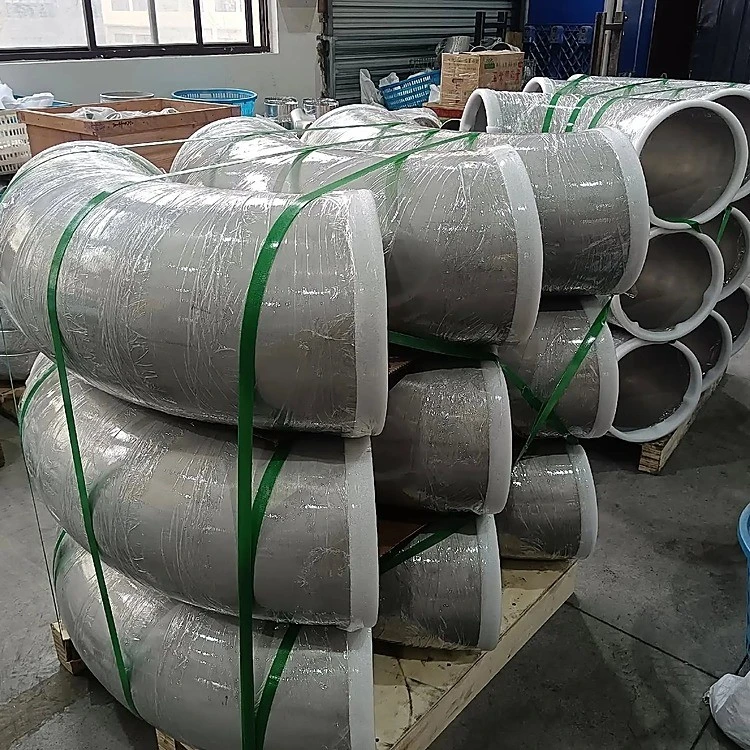
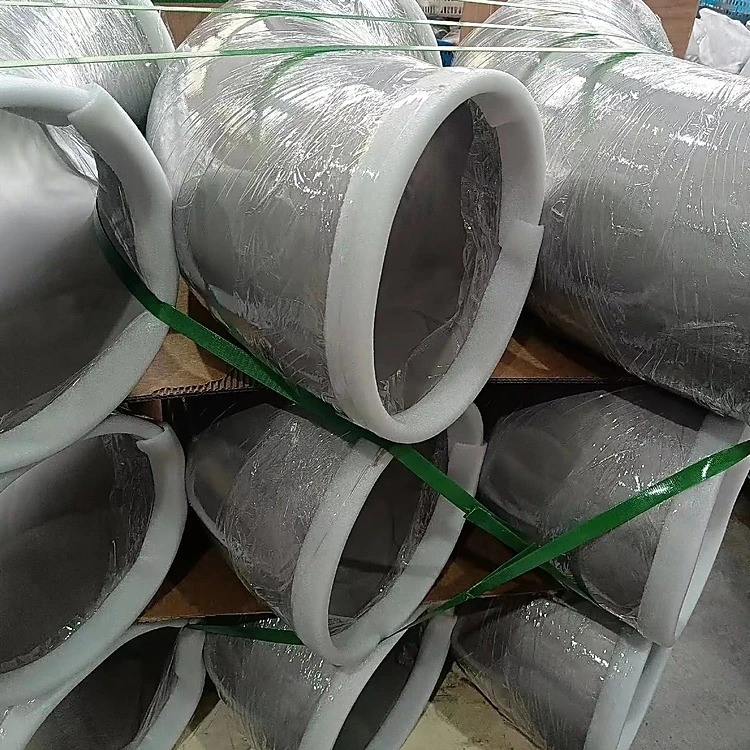
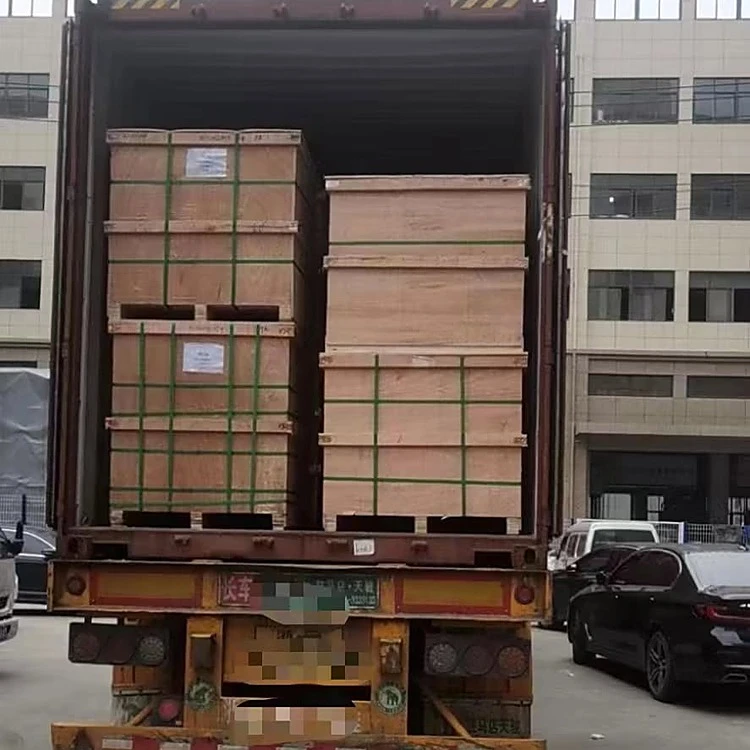
Send the elbow line items from your bill of materials - standard and edition, Type A or B, radius, angle, outside diameter, wall, quantity and the required impact temperature - and we confirm the product form, state the P355NL1 limits that apply and return an itemised offer with the test and document package named against each piece. For a cold-service line, low-temperature toughness and full-pressure wall are the two points worth settling first.
Related Products
ASTM A234 WP11 Butt Welding Elbow
ASTM A403 Stainless Steel Butt Weld Elbow
FAQ
What does EN 10253-2 Type B mean for a butt-weld elbow?
EN 10253-2 is the European standard for factory-made butt-welding fittings in non-alloy and ferritic alloy steels with specific inspection requirements. Within it, Type B denotes the heavier execution: the fitting body is made with an increased wall thickness so that after forming the bend or branch retains the pressure rating of the straight pipe at full operating pressure. A Type A fitting has the same nominal wall as the pipe and is the stock, general-purpose execution. Type B is chosen for pressure systems, tighter fit-up and critical lines where the wall lost during bending must be given back.
How does Type B elbow wall thickness differ from Type A at the bend?
A Type A elbow starts from the pipe nominal wall, so the extrados (outer radius) thins during hot or cold forming and the fitting is rated below the parent pipe. A Type B elbow starts from a heavier blank; the wall is built up in the bending zone and, for a tee, in the branch area, so the minimum wall after forming still satisfies the pressure design. EN 10253-2 sets the wall-thickness tolerance at the welding ends (minus 12.5 percent plus 20 percent above 4 mm for diameters up to 610 mm) and states that the Type B minus tolerance also applies to the increased internal wall values given in the standard annexes.
What is P355NL1 material and why is it used for low-temperature elbows?
P355NL1 (material number 1.0566) is a normalized, fine-grain, non-alloy steel for pressure purposes under EN 10028-3. The name decodes as P for pressure, 355 for the 355 MPa minimum yield at thickness up to 16 mm, N for normalized and L1 for the first low-temperature impact quality level. It is used for elbows in cold service because the normalizing treatment refines the grain and gives guaranteed Charpy toughness below freezing, which ordinary carbon steels such as P265GH do not offer. Typical uses include LNG and LPG auxiliaries, refrigerated process lines, cold-area piping and pressure equipment exposed to low ambient temperatures.
What mechanical properties must P355NL1 elbows meet at -40 degrees C?
For thickness up to 16 mm the minimum yield is 355 MPa and the tensile range is 490 to 630 MPa, with at least 22 percent elongation; the yield step falls to 345 MPa at 16 to 40 mm and 335 MPa at 40 to 60 mm. The defining low-temperature requirement is Charpy impact: in the normalized condition the longitudinal KV value is at least 40 J at minus 40 C, while the standard transverse value at the same temperature is 27 J. The 40 J figure quoted on cold-service purchase orders is therefore the longitudinal test result; the test direction, specimen size and test temperature should always be written into the order so the certificate reports the right value.
What diameters and wall thicknesses are available for EN10253 P355NL1 elbows?
R=1.5D long-radius elbows follow the EN 10253-2 dimension series. Common points include DN 25 at 33.7 mm outside diameter with a 38 mm centre-to-end, DN 50 at 60.3 mm with 76 mm, DN 80 at 88.9 mm with 114 mm and DN 100 at 114.3 mm with 152 mm, with wall thicknesses selected from the standard range, typically 4 to 12 mm for these sizes. Other diameters, 45 and 90 degree angles, short-radius R=1.0D and other bending radii can be quoted. The exact wall depends on the design pressure and the Type B build-up, so it is confirmed per line item rather than assumed from a catalogue.
Can EN 10253-2 elbows be supplied with EN 10204 3.1 material certificates?
Yes. The normal release document is an EN 10204 3.1 inspection certificate stating cast analysis and the mechanical and impact results for the heat, and 3.2 is available when the project or a notified body requires third-party validation. Because the elbow is formed from plate or pipe, the certificate chain should cover the starting material and the finished fitting, with heat numbers traceable to each piece. For P355NL1 in low-temperature service, confirm that the certificate records the minus 40 C Charpy value and the test direction, and add any project NDT such as UT or RT on the formed area as a separate clause.
How does EN 10253-2 compare with ASME B16.9 for butt-weld elbows?
Both standards cover factory-made butt-welding fittings, but they are not interchangeable. EN 10253-2 uses DN and outside diameters in millimetres, defines the Type A and Type B wall executions, and lists European pressure-vessel grades such as P235GH, P265GH and P355NL1 with their own impact rules. ASME B16.9 uses NPS and inch schedules and is normally ordered with ASTM materials such as A234 WPB or A420 WPL6. Dimensions, wall series and test requirements differ, so a replacement must be checked against the piping code rather than matched by nominal size alone. Where a project allows both, state the standard, material and wall execution explicitly on the purchase order.
What inspection and delivery documents come with a P355NL1 elbow order?
A normal package includes the EN 10204 3.1 material certificate with chemistry, tensile and minus 40 C impact results, dimensional and visual inspection records, and heat-number traceability to each fitting. Project work can add NDT on the formed zone, positive material identification and third-party witness points. Marking carries the standard, material grade, DN and wall, heat number and manufacturer identification. Commercial terms such as packaging, incoterms and delivery point are agreed in the individual offer rather than being fixed by the product standard.
Hot Tags: en10253 p355nl1 elbows, China en10253 p355nl1 elbows manufacturers, suppliers, factory


