


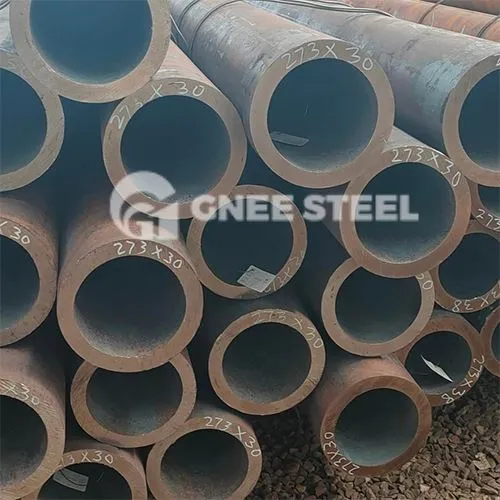


Products Description
Mechanical Tubes are a specialized term in metallurgical engineering, referring to metal pipes used in industrial piping systems. They are characterized by high strength, pressure resistance, and easy installation.
Classification by Structure
Rigid Tubes:
Larger bending radius and superior temperature resistance.
Suitable for compact layouts.
Flexible Tubes:
Better shock absorption and flexibility.
Ideal for connecting moving components.
Material & Standards
Materials: Carbon steel, alloy steel, stainless steel.
Compliance: ASTM A519, etc.
Specifications:
Nominal OD: Φ42mm–Φ219mm
Wall thickness: 2.5mm–40mm
Applications
Widely used in oil & gas pipelines and petrochemical process networks.
Products specification
Specification: O.D.: 20-610mm, W.T.: 2-60mm.
Inspection and Tests Performed of Production: Chemical composition, Mechanical properties, Hydrostatic test, Dimensional testing, Visual inspection, Nondestructive inspection.
Packing: Black Painting or Uncoated. With protective caps, beveled ends or plain ends.
Application: Oil, Gas, space, chemical, power boiler, military industry, structural industry etc.
Differences Between Mechanical Tubes and Fluid Tubes
1. Material Differences
Mechanical Tubes are typically used for transporting solid materials or high-temperature gases, requiring high wear resistance and thermal corrosion resistance. Common materials include cast iron, steel pipes, and copper pipes.
Fluid Tubes are designed for fluid media (liquids/gases), demanding higher material performance. They often use polymer materials, stainless steel, or fiberglass.
2. Structural Differences
Mechanical Tubes have a simpler structure, consisting mainly of elbows, tees, crosses, flanges, and pipes.
Fluid Tubes prioritize smooth internal surfaces for efficient fluid flow. They also include valves, pumps, and filters to optimize fluid dynamics.
3. Application Differences
Mechanical Tubes transport solids (e.g., slag, coal, ores) without needing to consider flow characteristics or friction losses.
Fluid Tubes carry liquids/gases, where friction losses and flow dynamics directly affect velocity and flow rate. Thus, factors like inner diameter, elbow count, and angles must be considered.
GNEE Mechanical seamless pipe


Hot Tags: en10297-1 astm a519 mechanical seamless pipe, China en10297-1 astm a519 mechanical seamless pipe manufacturers, suppliers, factory, A106 round carbon steel tube, ASME SA179 Mild Steel Pipe, ASTM A192 Seamless Carbon Steel Tubes, DIN 17175 St45 8 pipe, DIN 17175 St45 8 seamless steel pipe, Precision Seamless Steel Tubes for Automobiles


