


Starting from the basic principles, this article breaks down the four major heat treatment processes step by step, explaining the microstructural changes, process objectives, and field application scenarios.
Scope note: Unless stated otherwise, the examples below use hypoeutectoid steel (carbon content below ~0.77%) as the reference. Hypereutectoid (high-carbon) steels follow different rules for some operations - see the notes in each section.
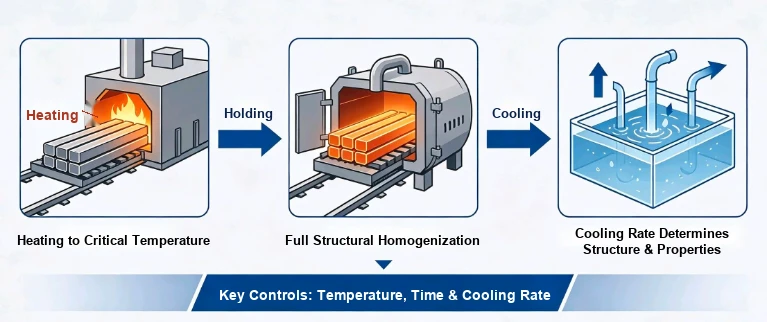
The underlying logic of heat treatment comes down to three core things: heating, holding, and cooling.
Heating: Raise the workpiece above the relevant critical temperature so that the steel's internal structure transforms into austenite (fully austenitized). For hypoeutectoid steel this means heating above Ac₃; for hypereutectoid steel, above Ac_cm.
Holding: Maintain the temperature for sufficient time so that the internal and external structure of the workpiece becomes uniform (austenite homogenization).
Cooling: This step is the key to phase transformation. Different cooling rates produce completely different metallographic structures and mechanical properties - ranging from pearlite (slow cooling) through bainite (isothermal transformation) to martensite (very rapid cooling).
Normalizing: Air Cooling to Refine Grains
Normalizing process: Heat the steel to Ac₃ + 30–50 °C (for hypoeutectoid steel; for hypereutectoid steel, Accm + 30–50 °C), hold, then remove the workpiece and cool it in air (in modern practice often forced-air or mist cooling, but "air cooling" remains its defining feature).
Its cooling rate is faster than annealing, the cooling time is shorter, and the resulting grain structure is finer.
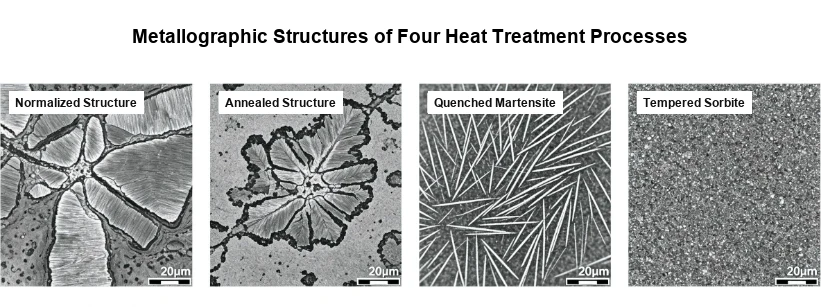
Take hypoeutectoid steel as an example: after heating and holding, the interior becomes austenite, which transforms into ferrite + pearlite during air cooling.
Core function: Refine grains, homogenize the material structure, and improve original structural defects in the steel.
Field use: As a preparatory heat treatment, it is often used to improve the structure of forgings and castings, preparing for subsequent machining or quenching.
Annealing: Slow Furnace Cooling to Reduce Hardness
Annealing process: For full annealing of hypoeutectoid steel, heat to Ac₃ + 20–30 °C, hold for a period of time, then cool it down slowly together with the furnace. It is the slowest cooling among the four processes. (Other annealing variants exist - spheroidizing annealing for hypereutectoid steels, stress-relief annealing, isothermal annealing - but full annealing is the reference case here.)
The structure of hypoeutectoid steel after full annealing is also ferrite + pearlite. But because cooling is extremely slow, the transformed products are coarser than those after normalizing.
Core function: Reduce the hardness of the steel and improve machinability; eliminate internal residual stress, stabilize the structure, and prevent deformation during subsequent processing.
Field use: Softening treatment of forging and casting raw materials, and stress relief.
Quenching: Rapid Cooling to Obtain High-Hardness Martensite
Quenching process: Heat the steel above the critical temperature (Ac₃ + 30–50 °C for hypoeutectoid; for hypereutectoid steel, Ac₁ + 30–50 °C to retain undissolved cementite), hold sufficiently, then rapidly immerse it in a cooling medium such as brine, water, or quenching oil for rapid cooling.
When the cooling rate is fast enough, the high-temperature austenite has no time to transform into pearlite and instead undergoes a shear-type (diffusionless) transformation directly, forming martensite - a supersaturated, extremely hard metallographic structure.
Core function: Greatly improve the hardness, wear resistance, and strength of the workpiece. Note: as-quenched martensite is extremely hard but also very brittle, with almost no ductility - it cannot be put into service in the as-quenched state.
Process drawback: Steel that has undergone quenching alone has poor toughness and huge residual internal stress. If it is not tempered afterward, the workpiece is highly prone to cracking.
Field use: Final heat treatment for parts requiring high hardness and wear resistance, such as cutting tools, gears, and bearings.
Cooling-medium nuance: Water quenching forms a vapor blanket (Leidenfrost film) in the martensite-formation temperature range (~200–400 °C), which can cause uneven cooling and cracking. This is why alloy steels - which have higher hardenability and therefore need a less severe quench - are usually oil-quenched.
Tempering: The Supporting Process After Quenching, Eliminating Quenching Stress
Tempering must be performed after quenching. Heat the quenched workpiece to below the critical temperature (below Ac₁), hold, then cool. Depending on the tempering temperature, the resulting structure differs:
Low-temperature tempering (150–250 °C): yields tempered martensite, retains high hardness, and reduces quenching stress. Used for cutting tools, measuring tools, and hardened surfaces.
Medium-temperature tempering (350–500 °C): yields tempered troostite, characterized by a high elastic limit. Used mainly for springs and elastic components.
High-temperature tempering (500–650 °C): yields tempered sorbite, balancing strength and toughness for good comprehensive mechanical properties.
Core function: Eliminate the residual internal stress generated by quenching, reduce brittleness, and adjust hardness.
The "quenching and tempering" (quench-and-temper / QT) treatment often mentioned in the industry is a combined process of quenching + high-temperature tempering, used to obtain good comprehensive mechanical properties. (In pipeline-steel terms, the "Q" in grades such as API 5L X65Q denotes this quenched-and-tempered condition.)
Field use: Parts subjected to alternating loads, such as shafts and connecting rods.
Cooling Medium Cooling Capacity Comparison (fastest to slowest)
Brine > Water > Quenching oil > Air > Furnace cooling
The faster the cooling rate, the higher the hardness of the resulting structure - but the greater the residual internal stress in the workpiece, and the higher the risk of deformation and cracking.
Brine has the strongest cooling capacity and is suitable for carbon steel quenching.
Quenching oil provides gentler cooling and is mostly used for alloy steel.
Air cooling corresponds to normalizing; slow furnace cooling corresponds to annealing.
Between martensite (very rapid cooling) and pearlite (slow cooling) lies bainite, obtained by isothermal holding in a bath - a structure offering an excellent strength-toughness combination used in isothermal quenching.
Summary of the Four Processes
Normalizing: air cooling, refines grains, homogenizes structure, mostly used for preparatory heat treatment.
Annealing: slow furnace cooling, reduces hardness, relieves stress, facilitates machining.
Quenching: rapid medium cooling, forms martensite, improves hardness and wear resistance; quenched parts must be tempered before service.
Tempering: follow-up process after quenching, releases internal stress, adjusts toughness; low-temp → tempered martensite, medium-temp → tempered troostite, high-temp → tempered sorbite; quenching + high-temperature tempering = quenching and tempering (QT).
Process Classification
Annealing and normalizing mostly belong to preparatory heat treatment, performed before rough machining to optimize the raw material structure.
Quenching and tempering (QT) belong to final heat treatment, performed before finish machining, determining the final service performance of the parts.
Comparison of Four Major Heat Treatment Processes
|
Process |
Cooling Method |
Metallographic Structure |
Main Purpose |
|---|---|---|---|
|
Normalizing |
Natural cooling in air |
Ferrite + Fine Pearlite |
Refines grains and produces a uniform microstructure |
|
Annealing |
Slow cooling inside the furnace |
Ferrite + Coarse Pearlite |
Reduces hardness and relieves internal stress |
|
Quenching |
Rapid cooling in water, oil, or salt bath |
Martensite |
Achieves high hardness and wear resistance |
|
Tempering |
Reheating after quenching, followed by controlled cooling |
Tempered Martensite / Tempered Sorbite |
Relieves internal stress and adjusts toughness |
Note: The faster the cooling rate, the higher the hardness and the greater the internal stress.