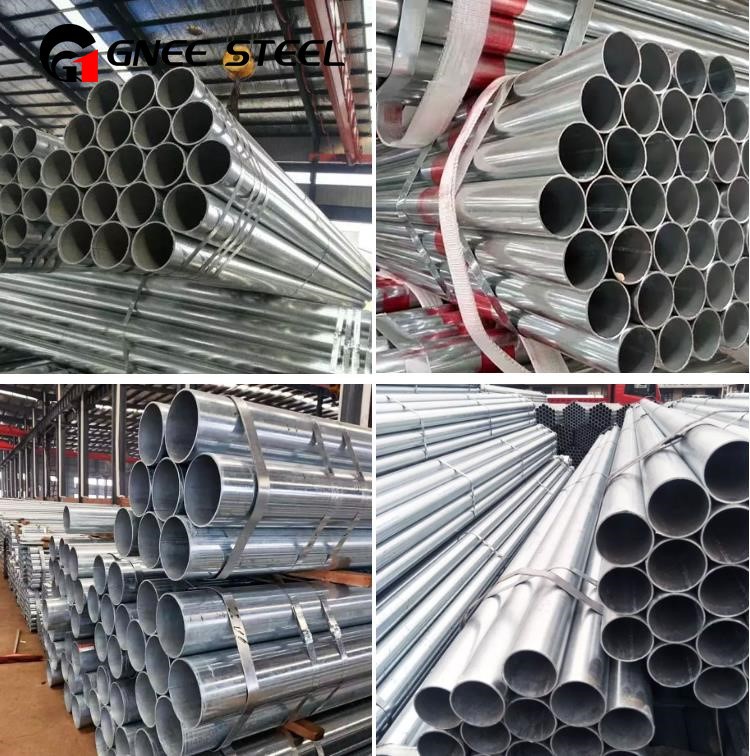
The main difference between different hot-dip galvanizing methods is how to activate the surface of the tube after acid leaching to improve the quality of galvanizing. Dry and redox methods are mainly used in production, and their characteristics are shown in the table. Galvanized steel pipes can be classified into hot-dip galvanizing and electro-galvanizing. Hot-dip galvanizing includes wet, dry, lead-zinc and redox processes.
The galvanized steel pipe has a galvanized surface that is smooth, compact and uniform in structure. Has good mechanical properties and corrosion resistance. The consumption of zinc is 60%-75% lower than that of hot-dip galvanized steel. The galvanizing process is more complicated, but it must be used for single-sided coatings, double-sided coatings of different thicknesses on the inner and outer surfaces.
Product Description
|
Standard |
ASTM A106, ASTM A53, API 5L Gr.B, DIN17175,DIN1629 |
|
Material |
ASTM A106B, ASTM A53B, API 5L Gr.B,ST52, ST37,ST44 SAE1010/1020/1045,S45C/CK45,SCM435,AISI4130/4140 |
|
Outer diameter |
13.7mm-609.6mm |
|
Wall thickness |
1.5mm-50mm |
|
Length |
3m-12m, random or fixed, as the clients' requests |
|
Technology |
Hot Rolled |
|
Tolerance |
Control with in the standard, OD:+/-1%, WT:+/-5% |
|
Advantages |
1.Short delivery time |
|
2.Quality assurance |
|
|
3.Competitive price |
|
|
4.Free Sample |