


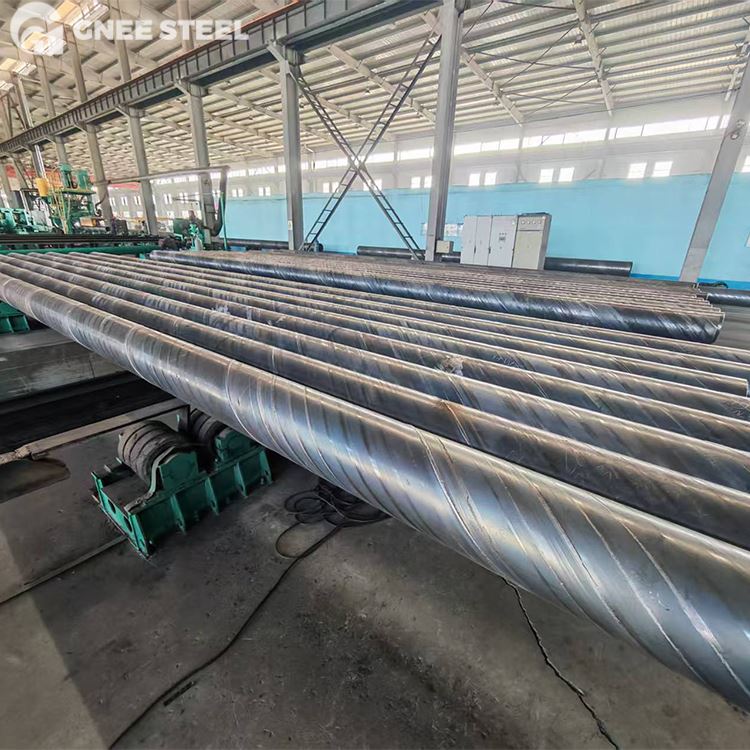
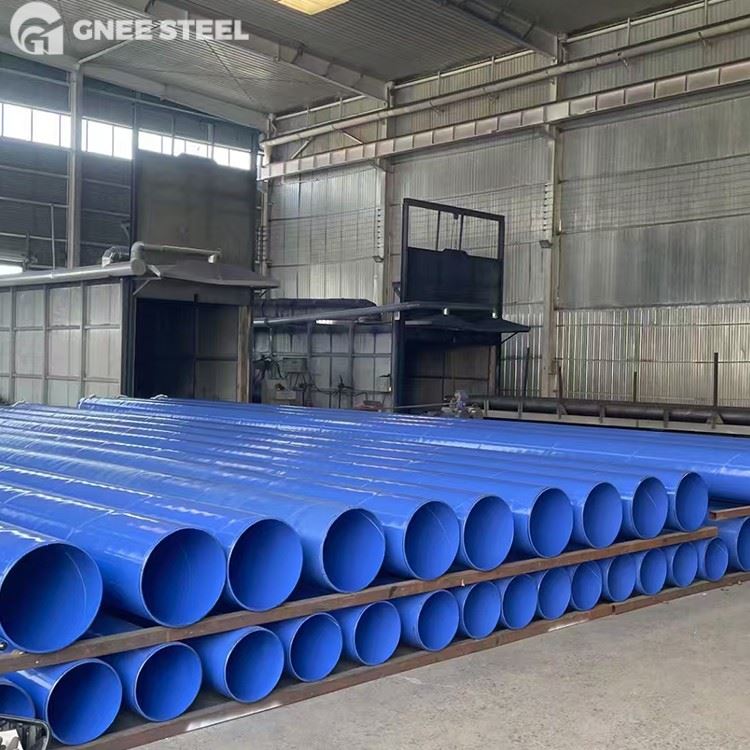
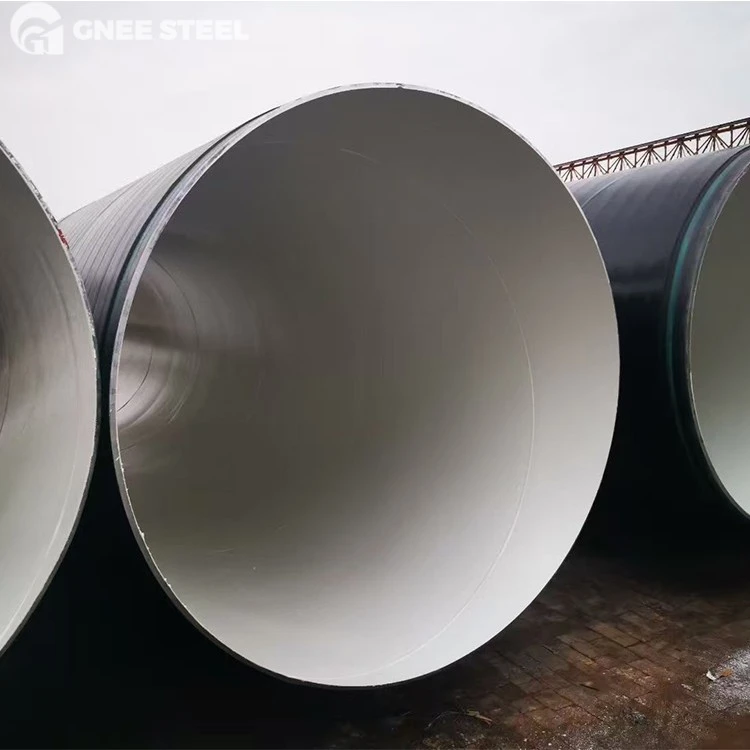
X52 PSL2 oil pipeline pipe belongs to the steel grade classification in the American Petroleum Institute (API) standards, and is divided into seamless pipe and welded pipe according to the manufacturing process. In API 5L and GB/T9711 standards, its corresponding steel grade is L360 or X52.
Corrosion-Resistant X52 PSL2 FBE Coated Pipes: Engineered for South America's Harsh Terrains.
Technical Specifications of API 5L X52 PSL2 Carbon Steel Line Pipe
| Feature | API 5L X52 PSL2 Specification |
| Yield Strength (min) | 360 MPa (52,200 psi) |
| Tensile Strength (min) | 460 MPa (66,700 psi) |
| Impact Testing | Required (0°C or lower) |
| Coating Standard | CSA Z245.20, AWWA C213, or AS 3894.3 |
| Common Sizes | 2" to 48" (Seamless & LSAW/ERW) |
Chemical Composition Design: The Art of Performance Balancing
The chemical composition of X52 (L360) is designed to maximize weldability, formability, and environmental adaptability while meeting strength requirements:
- Low Carbon (C) Base: Typically controlled within the range of 0.16%-0.22% (the specific upper limit depends on the manufacturing process and thickness). Low carbon is the core guarantee of excellent weldability and significantly reduces susceptibility to cold cracking.
- Manganese (Mn) Strengthening: As a core strengthening element (typically ranging from 1.25% to 1.50%), it effectively improves strength and toughness through solid solution strengthening, partially compensating for the strength loss caused by low carbon.
- Silicon (Si) Deoxidation: Appropriate addition (usually ≤0.45%) ensures the purity of molten steel and contributes to a certain strengthening effect.
Strict Impurity Control:
- Phosphorus (P): Significantly deteriorates toughness and weldability; strictly controlled to ≤0.025%.
- Sulfur (S): Easily forms sulfide inclusions, harming toughness, HIC resistance, and weld bead crack susceptibility; strictly controlled to ≤0.015% (stricter requirements in acidic environments).
Microalloying Essence (Key Differences):
- Niobium (Nb): A core microalloying element, achieving fine-grain strengthening by inhibiting austenite recrystallization and refining phase transformation microstructure, significantly improving the balance between strength and toughness.
- Vanadium (V): Auxiliary strengthening, contributing to precipitation strengthening effects.
- Titanium (Ti): Commonly used to fix nitrogen, forming TiN to refine the as-cast microstructure and protect Nb from excessive oxidation during continuous casting.
- Special Environmental Responses: For acidic service environments (containing wet H2S), additional strict control of carbon equivalent (Ceq/Pcm) and hardenability is required, and the content of elements such as copper (Cu) and nickel (Ni) may be limited to meet HIC/SSC resistance requirements.
Core Mechanical Properties: The Lifeline of Pipeline Safety
Strength Foundation:
- Yield Strength (Rt0.5): ≥ 360 MPa (52,000 psi) - The core basis for pipeline design calculations, ensuring pressure resistance.
- Tensile Strength (Rm): 460 - 570 MPa (67,000 - 83,000 psi) - Provides necessary strength reserve to prevent overload fracture. The yield-to-tensile ratio (Rt0.5/Rm) is typically controlled within a reasonable range (approximately 0.78-0.85) to ensure plastic deformation capacity.
Plasticity and Deformation Capacity:
Elongation (A): ≥ 21% (typical value at a 50mm gauge length) - High elongation ensures the pipeline's resistance to deformation (such as ground subsidence, geological disasters), stress redistribution, and crack arrest.
Toughness Assurance - Resistance to Brittle Fracture and Crack Arrest:
- Charpy V-Notch Impact Energy (CVN): Requires meeting minimum average and individual value requirements at 0°C or lower design temperatures (e.g., -10°C, -20°C) (specific values depend on the project's design temperature). This is crucial to preventing catastrophic brittle fracture of pipelines at low temperatures or under impact.
- Drop Weight Tear Test (DWTT): Particularly important for large-diameter, high-pressure pipelines. Requires a shear area percentage (SA%) ≥ 85% at lower temperatures (e.g., -5°C or -15°C) (common requirement). Excellent DWTT performance is key to ensuring rapid crack arrest after ductile initiation in long-distance pipelines, preventing the escalation of accidents.
- Hardness Control: Typically requires Vickers hardness (HV10) ≤ 248 or Brinell hardness (HB) ≤ 232. Limiting hardness is essential to preventing cold cracking in welds and meeting SSC resistance requirements in acidic environments.

API 5L X52 PSL2 Pipeline FBE Anti-corrosion Treatment Process:

Surface Pretreatment:
Shot blasting is used to remove rust and scale from the steel pipe surface.
Standard: Must meet ISO 8501-1 Sa 2.5 grade. The surface should have a near-white metallic color and form an anchor profile depth of 40-100μm to enhance coating adhesion.
Online Inspection and Cleaning:
High-pressure air is used to blow away residual abrasive, and surface salt content is tested to ensure no contamination residue remains.
Medium-Frequency Induction Heating:
The steel pipe is uniformly heated to 180°C - 230°C. This temperature range is the optimal temperature for epoxy powder to melt and cure.
Electrostatic Spraying:
- Epoxy powder is charged through a spray gun and uniformly adsorbed onto the heated pipe surface. The powder melts, flows, and cures upon heating.
- Thickness Control: The typical thickness of a single FBE layer is between 300-500 μm.
Water-Cooled Curing:
After spraying, the steel pipe passes through a water-cooling channel, allowing the coating to harden rapidly and reach a stable state.
Holiday Detection:
100% full-line inspection. An electric spark leak detector (typically set to 2000V-2500V) is used. Even a pinhole invisible to the naked eye will be detected and repaired.
Coating Adhesion Testing:
Bend tests and cathodic disbondment tests ensure the coating will not peel off in polar or underwater environments.
Pipe End Processing of API 5L X52 PSL2 FBE pipeline

Beveling:
- Standard: According to API 5L standard, pipe ends are typically beveled at 30° (+5°, -0°), with a root face of approximately 1.6mm.
- Purpose: To ensure sufficient weld penetration during on-site butt welding, guaranteeing that the mechanical properties of the joint are consistent with the pipe body.
Cutback:
The FBE coating does not cover the very top of the pipe. Typically, a 50mm-150mm bare steel area is left at each end.
Purpose: To prevent the high temperature during welding from scorching the anti-corrosion layer and to facilitate clamping with welding clamps.
Packaging Methods of API 5L X52 PSL2 Epoxy Coated Pipe
While FBE (Fused-Bound Epoxy Powder) coating offers strong corrosion resistance, it is also brittle and susceptible to damage from severe impacts and scratches. Therefore, its packaging specifications are typically higher than those for ordinary black tubing.
Grouping by Size:
Small Diameter (typically < 8"): Hexagonal Bundles are used. Each bundle is secured with steel straps, and a protective layer (such as rubber pads or cardboard) is placed under the steel straps to prevent the steel straps from damaging the FBE coating.
Large Diameter (typically ≥ 10"): Loose packaging is used. Each tube is stacked separately, and rubber pads or straw rope curtains are usually placed between tubes to prevent friction damage to the coating during transportation.
End Protection:
Tube Caps: High-strength plastic caps or recessed plugs must be used to prevent rainwater, sea sand, and small animals from entering the tube.
Beveling Protection: Apply rust-preventive oil (Varnish) to the bevel and install steel protectors to cope with potentially rough handling at South American ports.
Lifting Reinforcement:
Nylon slings are provided for each bundle or each pipe. Direct contact between steel wire ropes and the pipe body is strictly prohibited to protect the integrity of the FBE coating.

Transportation Modes of API 5L X52 PSL2 pipeline for oil and gas:
Shipments from China or other regions to South America (such as Santos, Brazil/Valparaiso, Chile/Buenaventura, Colombia) typically take 45-60 days.
Container Loading (20GP/40HC):
Applicable Scenarios: Small batch orders or steel pipes with smaller diameters (usually less than 11.8 meters in length).
Reinforcement Requirements: Strict wooden bracing is mandatory. All timber used meets ISPM 15 standards (fumigation treatment).
Breakbulk Vessel Transportation:
Suitable for: Large-volume project orders, or pipes with large diameters and lengths exceeding 12 meters.
Storage Selection: Choose the under-deck for storage to avoid exposure to sunlight (UV radiation can cause FBE coating aging and discoloration) and direct seawater runoff.

Reliable X52 PSL2 FBE Pipes for LATAM: Sea-Ready Packaging & Specialized Port Delivery.
FAQ
What is API 5L X52 equivalent to?
According to chemical composition, mechanical properties and so on technical data comparison, the API 5L X52 equivalent plate material is L360 steel, which is usually made into L360 steel plates or L360 steel pipes used in the petroleum and gas industry for pipeline transportation systems.
What is the strength of X52 material?
Grade X52 indicates 52000 PSI minimum yield strength and 66000 PSI minimum ultimate tensile strength.
What is the density of st52 steel?
A St 52 Steel grade is designed with a density of 7.85 g/cm3 and has a hardness of Brinell 180.
Hot Tags: api 5l x52 psl2 fbe coated line pipes, China api 5l x52 psl2 fbe coated line pipes manufacturers, suppliers, factory, api 5l tubing exporters, steel pipe api 5l seamless exporters, api 5l pipe specification, seamless tubing api 5l grade, seamless api 5l pipe importers, tubing api 5l seamless grade


