


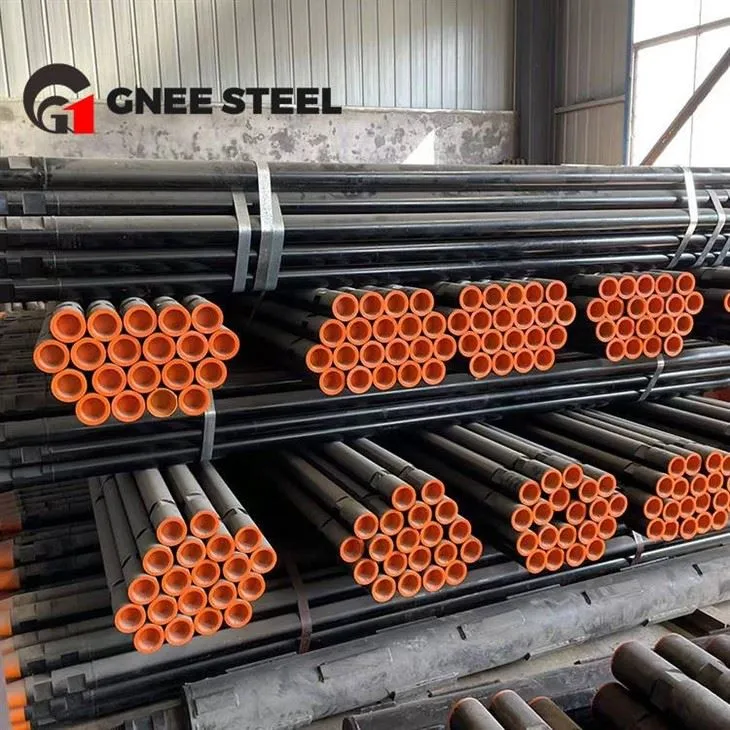

What is API 5L X52 PSL2 Steel Pipe?
API 5L X52 PSL2 grade carbon steel seamless pipe is used in the oil and gas industry to transport oil, gas and water. API 5L X52 PSL2 grade pipe is available in seamless and welded types and is commercially known as API 5L line pipe.
What is the equivalent ASTM material for API 5L X52 Seamless Round Pipe?
API 5L X52 PSL2 pipe has a high yield strength of 52,000 psi and is suitable for high pressure applications. It has equivalent ASTM specifications A53 Grade B and EN10208 L360MB or GB/T9711 L360 and isO3183 L360 as grades.
API 5L X52 pipe also called L360 Pipe, X52 (L360) named by minimum yield strength 52 Ksi (360 Mpa). It's a medium grade in API 5L and ISO 3183 specifications, used for oil and gas pipeline transmissions.
Chemical Composition of API 5L X52 PSL2 Pipes with t ≤ 0.984"
| Steel Grade | Mass fraction, % based on heat and product analyses | Carbon Equiv a | |||||||||||||||||||
|---|---|---|---|---|---|---|---|---|---|---|---|---|---|---|---|---|---|---|---|---|---|
| C | Si | Mn | P | S | V | Nb | Ti | Other | CE IIW | CE Pcm | |||||||||||
| max b | max | max b | max | max | max | max | max | max | max | ||||||||||||
|
Seamless and Welded Pipe |
|||||||||||||||||||||
| X52N | 0.24 | 0.45 | 1.4 | 0.025 | 0.015 | 0.1 | 0.05 | 0.04 | d,e,l | 0.43 | 0.25 | ||||||||||
| X52Q | 0.18 | 0.45 | 1.5 | 0.025 | 0.015 | 0.05 | 0.05 | 0.04 | e,l | 0.43 | 0.25 | ||||||||||
Mechanical Properties Tensile and Yield of API 5L X52 PSL2 Pipe
| Pipe Grade | Tensile Properties – Pipe Body of SMLS and Welded Pipes PSL 2 | Seam of Welded Pipe | |||||
|---|---|---|---|---|---|---|---|
| Yield Strength a | Tensile Strength a | Ratio a,c | Elongation | Tensile Strength d | |||
| Rt0,5 PSI Min | Rm PSI Min | R10,5IRm | (in 2in) | Rm (psi) | |||
| Af % | |||||||
| Minimum | Maximum | Minimum | Maximum | Maximum | Minimum | Minimum | |
| X52N,X52Q,X52M | 52,200 | 76,900 | 66,700 | 110,200 | 0.93 | f | 66,700 |
API 5L Carbon Steel Line Pipe

Core Applications of API 5L X52 PSL2 Pipeline Pipes: Backbone of Energy Networks
- Onshore/Subsea Oil and Gas Gathering and Transmission Pipelines: The main trunk connecting wellheads, processing plants, and the starting points of long-distance pipelines.
- Medium and Low Pressure Long-Distance Transmission Trunk Lines: Undertaking the core task of large-scale cross-regional transportation of oil and gas resources (especially X52, which has been widely used in historical projects and remains an important choice).
- Urban Gas Pipelines: A key component of medium-pressure distribution systems, ensuring the safety of gas supply for both residential and industrial use.
- Water/Gas Injection Pipelines: Important engineering pipelines for increasing and stabilizing oilfield production.
- Industrial Gas Transportation: Oxygen, nitrogen, carbon dioxide, etc.
- Hydraulic Pipelines: Large-scale water diversion projects, power plant circulating water pipelines (corrosion protection requirements vary).
- Structural Pipe Pipes: Utilizing their excellent mechanical properties and weather resistance, used in wharves, foundations, etc.
FAQ
- Are X52 and L360 the same thing?
Yes. X52 is the designation in the API 5L standard (based on psi), and L360 is the designation in the ISO 3183 standard (based on MPa). Both represent pipeline steel grades with a minimum yield strength of 360 MPa (52,000 psi), and their technical requirements and performance are completely equivalent.
- What is the difference between X52 (L360) of PSL1 and PSL2?
PSL2 has more stringent requirements: including higher Charpy impact energy requirements (especially for the base metal and weld), tighter dimensional tolerances (such as wall thickness and ovality), additional non-destructive testing requirements (such as tube body UT), and more detailed marking and documentation requirements. PSL2 is suitable for more demanding or critical service conditions.
- Can X52 (L360) be used in environments containing hydrogen sulfide?
Yes, but a grade that meets acid resistance requirements (HIC & SSC) must be selected. When procuring, it is essential to clearly specify compliance with standards such as NACE MR0175/ISO 15156 and ensure compliance with relevant tests (e.g., HIC test CLR/CTR/CSR compliance, SSC test showing no cracking under specified stress). Ordinary grades are not suitable for acidic environments.
- Why is the DWTT test so important for pipelines?
The DWTT (Drop Weight Tear Test) more realistically simulates the ductile tearing behavior and crack arrest capability of pipelines during actual fracture, especially for thick-walled, high-pressure pipelines. Excellent DWTT performance (high shear area percentage) is crucial to ensuring that cracks can be quickly stopped once ductile initiation occurs, preventing catastrophic accidents caused by long-range run-through cracking. Its importance is no less than, and may even exceed, the Charpy impact test.
- What precautions should be taken when welding X52 (L360) produced using the TMCP process?
The core is controlling heat input and layer temperature. The superior performance of TMCP steel relies on its fine microstructure. Excessive welding heat input or layer temperature can lead to grain coarsening in the heat-affected zone (HAZ) and a significant decrease in toughness. Strict adherence to the qualified Welding Procedure Specification (WPS) is essential.
Gnee Group participated in the NECC exhibition

Gnee Customer visit

Gnee Factory

Gnee Packaging and shipping

Hot Tags: api 5l x52 psl2 seamless steel pipe, China api 5l x52 psl2 seamless steel pipe manufacturers, suppliers, factory, seamless api 5l pipe cost, api 5l pipe thickness, steel tubing api 5l seamless price, api 5l tubing, steel pipe api 5l seamless specification, api 5l pipe specification


