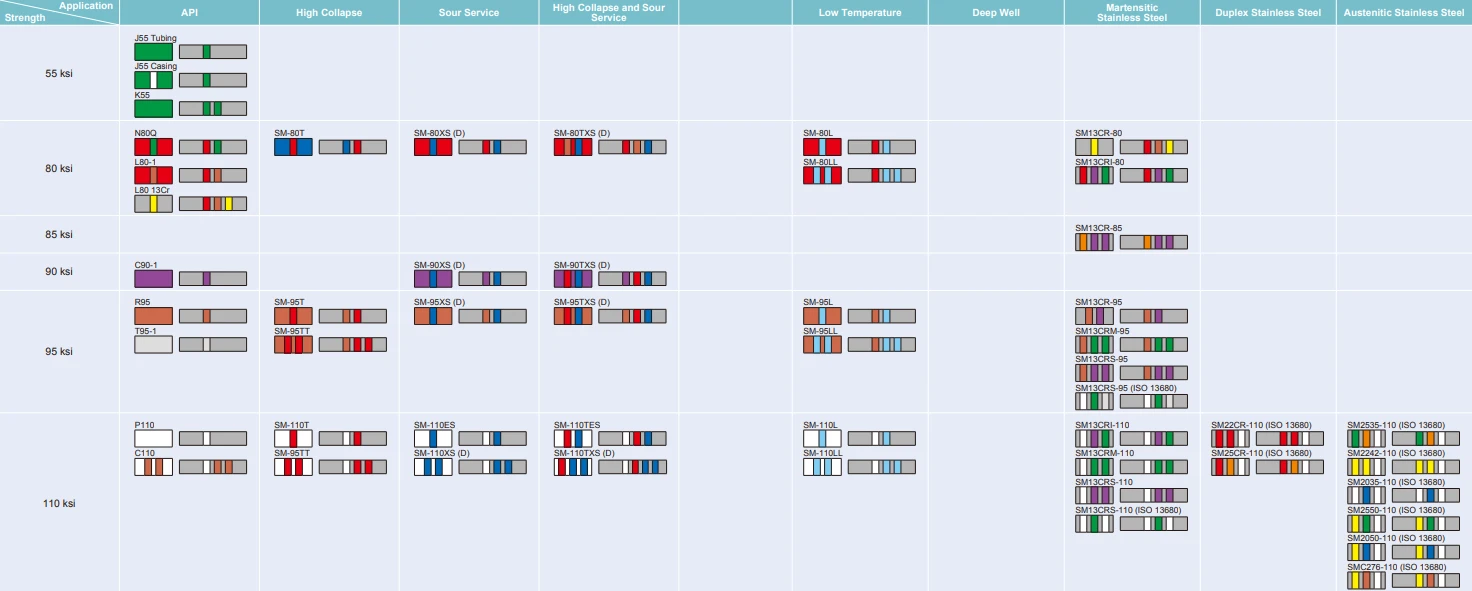
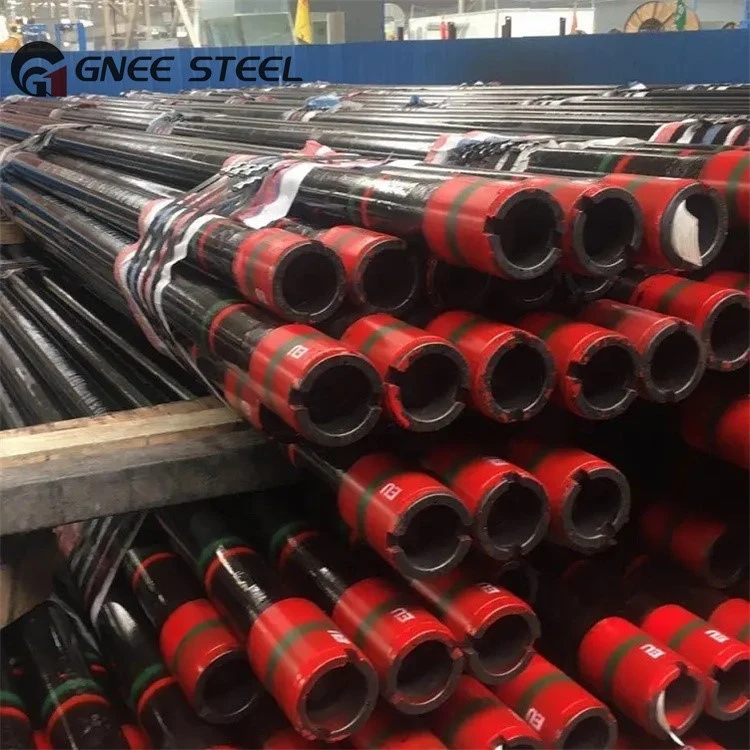
Gnee offers a full range of API 5CT casing and tubing to meet all types of petroleum exploration and production needs. Materials include carbon steel (most commonly used), alloy steel, chromium steel, and high-alloy steel. API 5CT grades cover J55/K55, N80 Type 1 and N80Q, L80, C90, T95, P110, Q125, with additional 13 Cr requirements.
Scope of supply
Enpro offers API 5CT sleeves in the following sizes and specifications:
Standards and grades: API 5CT J55/K55, N80-1, N80Q, C90, T95, P110, Q125 and 13Cr
Casing size range: 5 1/2" to 20" length, typically R3.
Pipes Pipe sizes range: 1.0", 1.315", 1.66", 1.9", 2.063", 2 3/8", 3 1/2" and 4 1/2", lengths in R2.
Casing connection types: BTC (threaded connection support), LTC (oblong threaded connection), advanced connection.
Pipe connection type: BTC, NUE, EUE,
casing
The casing has a circular cross-section and is a large-diameter pipe that is inserted into the oil well and fixed with cement to protect other equipment. Most of it is made of steel. Wells must be designed to withstand forces that differ from external forces, such as fragmentation, explosions, stresses, and chemical corrosion.
API 5CT casing is used to support the wall of oil and gas pipes to ensure normal operation during the drilling process and after completion. Each well uses several layers of casing depending on the drilling depth and geological conditions. The cemented casing is used to go down the well. Unlike oil pipes and drill pipes, it cannot be reused and is a one-time consumable material. Therefore, casing consumption accounts for more than 70% of all oil well pipes. According to the use, it can be divided into casing, surface casing, casing and production casing.
OCTG oil pipe
The OCTG tubing is located inside the casing as it is the conduit through which the oil flows. The oil pipe is the simplest part of the OCTG and usually occurs in 30ft (9m) pipe sections with threaded connections at both ends. The pipeline is used to transport natural gas or crude oil from a producing formation to a facility where it is processed after drilling is completed.
The oil pipe (pump pipe) goes inside the casing as it is the pipe through which the oil flows out. Production pipe is a simple section of OCTG, typically found in 30ft (9m) pipe sections with threaded connections at both ends. The pipeline is used to transport natural gas or crude oil from a producing formation to a facility where it is processed after drilling is completed.